
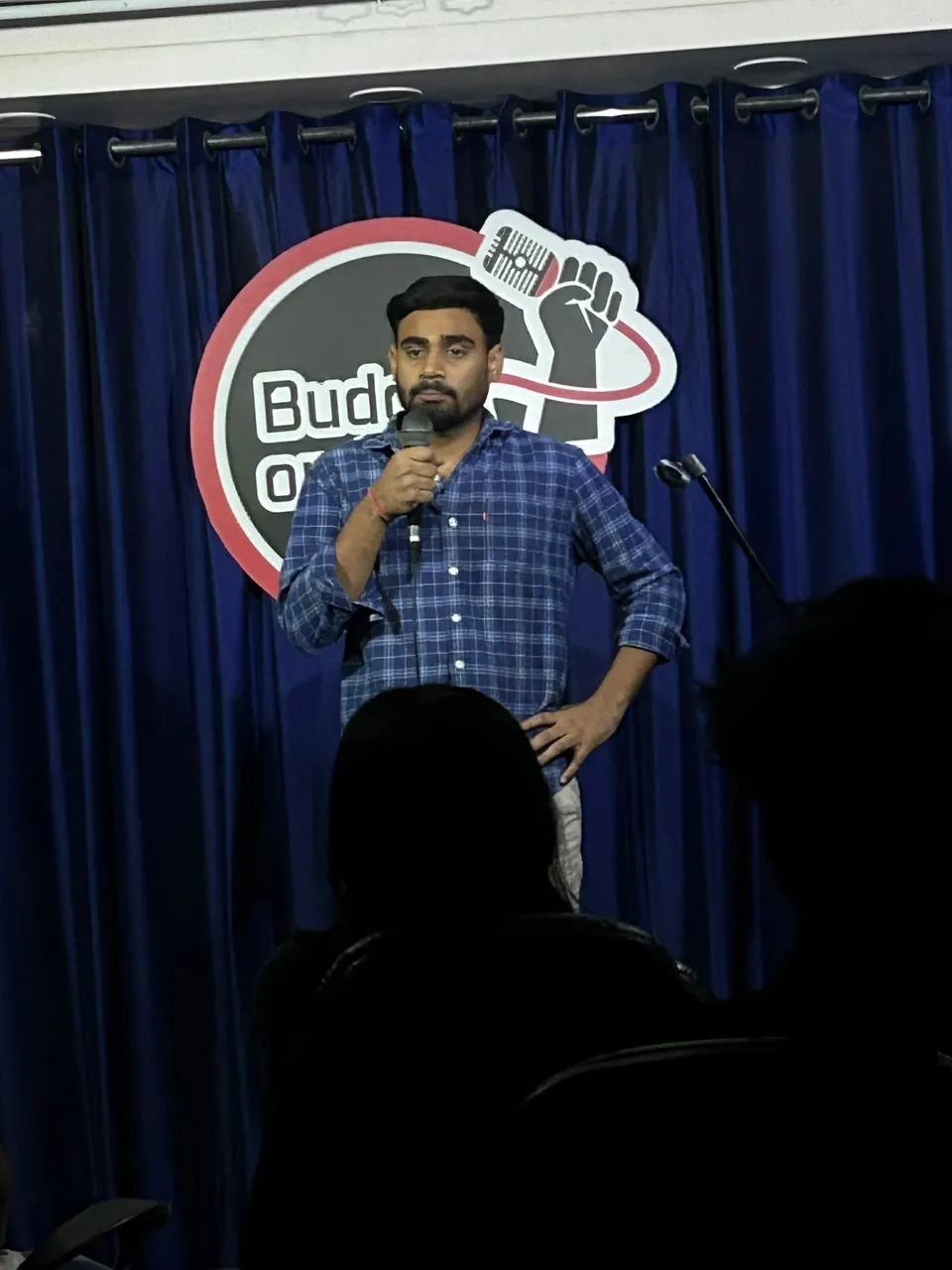
The fastest way to get honest feedback on your stand-up comedy is to stop asking your friends and start asking four better sources: a room full of strangers, a recording of your set, experienced comics, and a second pair of ears that goes through the tape for you. Each one tells you something the others cannot. Together they turn “I think it went okay?” into “I know exactly what to fix on Thursday.”
But first, let us deal with the four most dangerous words in Indian comedy.
Why “Badhiya Tha Bhai” Is Not Feedback
You walk off stage. Your heart is doing 140. Your college friend, who came because you promised him chai afterwards, slaps your back: “Badhiya tha bhai.” It feels great. It means nothing. Not because he is lying — he genuinely enjoyed watching you not faint — but because it contains zero information.
- Friends laugh at the wrong things: the inside reference only they understood, the line you stumbled on, your shirt.
- They grade on effort: “You went up! On a stage! Legend!” True. Also not a note on your punchline.
- They avoid awkwardness: nobody wants to tell a friend over momos that minute three was a desert.
- They remember the vibe, not the moments: ask which joke got the biggest laugh and watch them guess.
Support is the petrol that keeps you coming back to the mic. Feedback is the steering wheel. Driving with only petrol is how you end up very fast in a ditch.
What Does Good Feedback on a Comedy Set Look Like?
Useful comedy feedback has three ingredients. If a note is missing any of them, it is an opinion, not a tool.
- It is specific: not “the middle was slow” but “the Shaadi.com bit dragged”.
- It points at a moment: ideally with a timestamp — “around 3:40 the room went quiet for almost a minute”.
- It comes with a fix you can try: “cut the first two lines of the setup and get to your dad’s reaction faster”.
Compare “bhai thoda aur energy chahiye” with “you rushed the punchline at 2:14 — pause for one second before it”. The first gives you vague guilt. The second gives you homework.
What a useful note looks like
- [01:05] “Dadi ka Instagram” line pe solid laugh — keep it.
- [03:40–04:30] Room quiet — setup bahut lamba. Try: pehli 2 lines cut karo.
- [05:10] Punchline ke baad turant next joke — laugh ko saans lene do.
- Next set focus: opener ko 20 second mein khatam karo.
Where Can Comedians Get Honest Feedback?
1. A Room Full of Strangers
Strangers do not owe you a laugh, which is exactly why they are the most honest critics in the building. A laugh from a stranger is earned; silence from a stranger is information. Perform where nobody came for you — a beginner-friendly open mic is the best comedy lab there is.
2. Your Own Recording
Your memory of a set is a liar. Adrenaline edits everything: the bomb feels longer, the laugh feels bigger, the stumble disappears. Your phone, kept near the stage, remembers exactly what happened — including the two seconds of silence after your “best” line.
3. Experienced Comics
People who have done hundreds of sets hear things a beginner cannot: an unclear premise, a tag hiding in your own sentence, an act-out begging to happen. Ask a narrow question (“was the opener too long?”) and you get a narrow, useful answer. Ask “kaisa tha?” and you get “badhiya tha” again, just from someone with more followers.
4. AI Feedback on Your Recording
The problem with recordings is that nobody actually re-listens to six minutes of themselves. It is painful. This is where AI feedback on your set earns its place: upload the recording and get the moments that matter — where the audience laughed or clapped, where it went quiet, your pace and pauses, what worked, what to fix, and one focus for your next set — on WhatsApp, in Hindi, Hinglish or English. It does not replace the room or a senior comic. It just makes sure you actually look at the tape.
Your recording already knows what happened.
Upload your last set and get timestamped feedback on where the room laughed, where it drifted and exactly what to try next time. Shared only with you.
Analyse My SetHow To Ask for Feedback Without Getting Useless Answers
- Ask about one thing: one joke, one section, one transition. Not “how was it?”
- Listen, do not defend: “nahi, woh joke actually funny hai” — the room already voted. Write it down, argue later.
- Do not fix everything at once: ten notes after one set means you change nothing. Pick one.
- Do not trust one bad night: a dead Tuesday crowd is a data point, not a verdict. Test a joke in two or three rooms before you bury it.
- Save the hard notes, not just the nice ones: a folder of compliments is a scrapbook, not a set.
How Do You Use Feedback To Improve Your Comedy?
Here is a simple loop that works for comics, poets and storytellers alike:
- Record every set. Phone near the stage, audience audible.
- Find the moments: the biggest laugh, the longest silence, the line you rushed.
- Choose one fix — the change most likely to make the next set better.
- Perform again within a week, while the material is still warm.
- Compare. Did the fix work? Keep it. Did it not? Try the next one.
No secret workshop, no guru. Reps plus honest notes, repeated until the set gets tight.
Support gets you back on stage. Feedback decides what you bring with you when you get there.
Final Thoughts
Keep your friends. Bring them to every show. Let them say “badhiya tha bhai” as loudly as they want — you earned it by walking up there. Just do not mistake the hug for the map.
For the map, go to the honest sources: strangers, your recording, comics who have been at it longer than you, and a second pair of ears that listens to every second you would rather skip. Then pick one thing, fix it, and get back on the mic.
Need a room full of honest strangers?
Book a beginner-friendly slot at a Buddy On Stage open mic. Performers get AI feedback on their set free during our testing phase.
Book an Open Mic Slot