
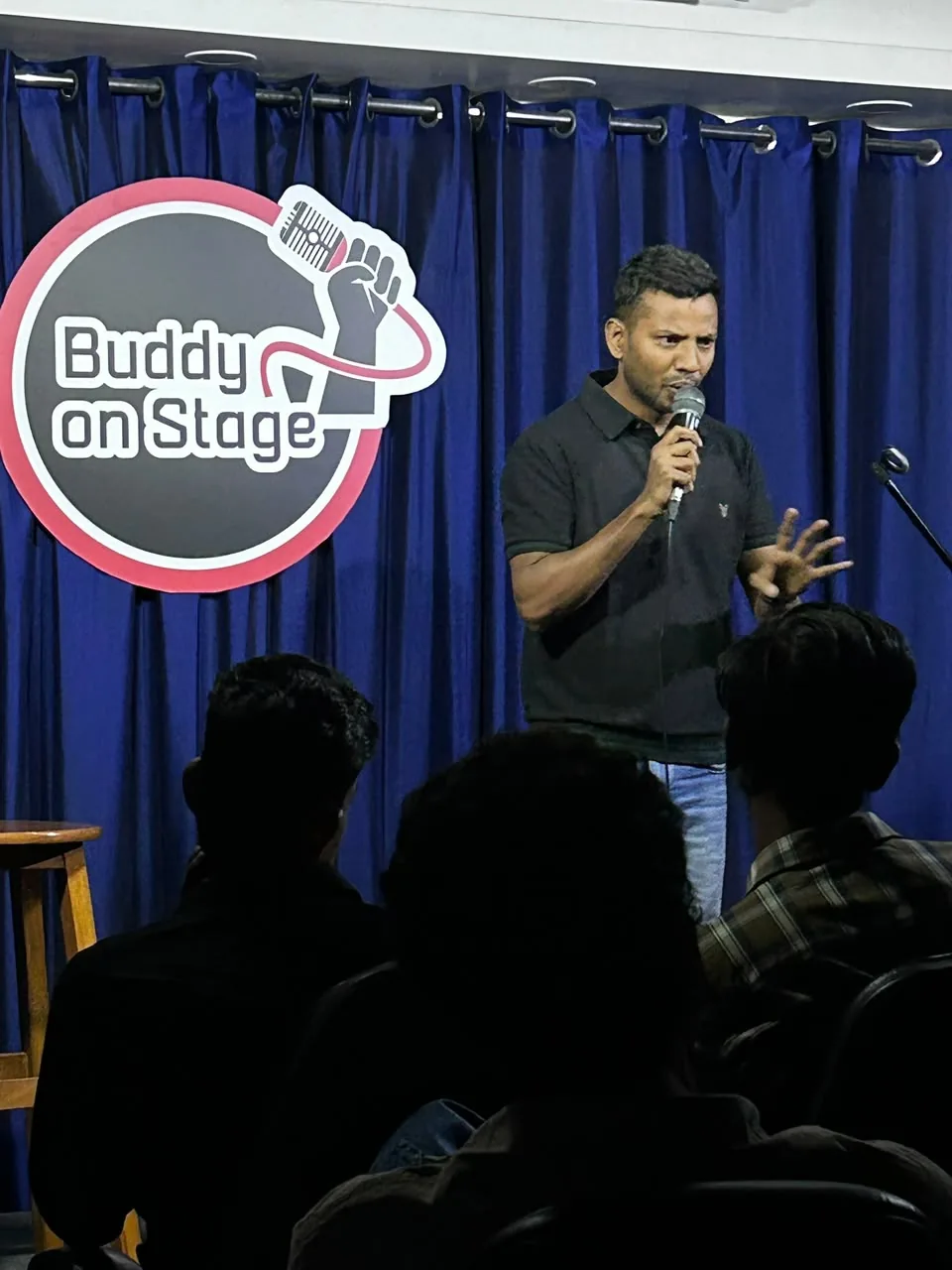
The quickest way to get more laughs in your comedy set is not to write more jokes — it is to squeeze more laughs out of the jokes you already have. Shorter setups, extra punchlines (tags), act-outs, better pauses and cutting the dead air between bits will raise your laugh count faster than any new material. Then you measure the result with one simple number: laughs per minute.
Let us go through the seven fixes, from easiest to most fun.
How Do Comedians Get More Laughs?
1. Cut Your Setups in Half
Every sentence before the punchline is a sentence where nobody laughs. Most beginner setups carry a full biodata — which cousin, which city, which year, which WhatsApp group. The audience needs about a third of it. Read your setup and ask of each line: does the punchline die without this? If not, cut it. A shorter runway means the laugh arrives sooner, and sooner laughs mean more laughs per minute.
2. Add Tags After Your Punchlines
A tag is a second (or third) punchline on the same setup, with no new setup needed. “My dad finally learned UPI.” Laugh. “Now he sends me one rupee to check if I’m alive.” Bigger laugh. You did not write a new joke; you mined the old one. Look at your strongest joke and ask: what else is true about this situation? There is almost always a tag hiding in there.
3. Act It Out Instead of Describing It
“My mom got angry” is information. Doing your mom — the voice, the slipper hand, the “haan, haan, tum toh bade ho gaye ho” — is comedy. Act-outs often get a laugh on top of the punchline, because the audience laughs at the performance itself.
4. Pause Before the Punchline
Nervous comics rush. A tiny beat before the punchline lets the audience lean in and makes the twist land harder. And after the laugh, wait. Talking over a laugh kills it early and steals the next one.
5. Put the Funny Word Last
The laugh comes at the surprise. If the surprise word sits in the middle of the sentence and you keep talking, the laugh gets swallowed. Rearrange so the funniest word is the last thing you say, then stop.
6. Cut the Dead Air Between Bits
“So… anyway… haan toh… relationships.” That eight-second shuffle between jokes is laugh-free time. Write clean transitions, or just move straight to the next premise in one line.
7. Drop or Move the Weakest Bit
Every set has one bit you keep because you love it, not because the room does. Moving it, shrinking it or dropping it can lift the whole set — and give you time for a joke that works.
Find out which fix your set needs.
Upload your recording and get the laughs, claps and quiet stretches with timestamps — plus two to four concrete fixes and one focus for your next set.
Analyse My SetHow Do You Measure Laughs in a Comedy Set? (LPM)
You cannot improve what you only “feel”. That is where laughs per minute (LPM) comes in: the number of real audience laughs divided by the length of your set. Six-minute set, eighteen laughs, LPM of three. Class 10 maths, no calculator.
- Record the set with your phone near the stage so the audience is audible, not just you.
- Play it back and jot the timestamp of every clear laugh — 0:42, 1:15, 1:31.
- Count honestly: your one loyal friend’s “haha” does not count. Note applause breaks separately.
- Look at the gaps between timestamps — that is where your next fix lives.
Not keen on re-listening to your own voice for six minutes? AI feedback on your recording marks where the audience laughed or clapped, down to the second, and the stretches that went quiet.
Laugh map from a 6-minute set
- [00:38] Pehla laugh — opener ne kaam kiya.
- [01:52] Biggest laugh, 3.5 sec — pause before punchline worked.
- [02:40–03:50] Koi laugh nahi — setup chhota karo.
- [05:30] Closer pe applause break.
What Is a Good Laughs Per Minute?
Honest answer: anyone giving you a magic number is guessing. A rapid one-liner comic and a slow-burn storyteller can both kill with very different LPMs, and a Tuesday room of eight gives the same joke a different score than a packed Saturday. The only comparison that matters is you versus your last set. Same jokes, new room — did the count go up? Did the dry stretch in minute three shrink?
A One-Week Plan To Get More Laughs From the Same Set
You do not need a new five minutes. You need one focused week with the five minutes you already have:
- Day 1 — Count: listen to your last recording and note every laugh and the longest gap.
- Day 2 — Cut: take the bit inside that gap and cut its setup by a third. Read it out loud with a timer.
- Day 3 — Tag: pick your single strongest joke and write five possible tags. Keep the best one.
- Day 4 — Act out: find one line where you describe a person and try performing them instead.
- Day 5 — Perform: take only these changes to an open mic and record again.
- Day 6 — Compare: same jokes, new version. Did the gap shrink? Did the tag land? Keep what worked.
Repeat the loop and your set gets funnier every week, often without a single brand-new joke.
Common Mistakes When Chasing More Laughs
- Adding jokes instead of cutting words: a longer set with the same laughs is a weaker set.
- Cheap crowd work to spike the count: it feels great tonight and builds nothing you can take to the next stage.
- Changing five things at once: you will never know which fix worked.
- Judging from one night: one dead room is weather, not climate. Look across three or four sets.
Final Thoughts
More laughs is not magic. It is editing: shorter setups, more tags, sharper act-outs, cleaner pauses, less dead air. Then counting honestly to see if it worked.
Homework: record your next set, find your longest laugh-free gap, apply one fix from this list, and go back up to count again. Need a stage? Book a slot at a Buddy On Stage open mic — the room is real, the laughs are earned, and the scoreboard is honest.