Stand-Up Comedy for Beginners:
How to Write Your First 5-Minute Set
You've been making people laugh your whole life. Now it's time to do it on purpose, on a stage, with a microphone. Here's a step-by-step guide to writing your first stand-up comedy set — from blank page to stage-ready in one sitting.
Understanding the 5-Minute Set
Before you write a single joke, you need to understand the format you're writing for.
Five minutes sounds short. It isn't. Five minutes of stand-up comedy is approximately 600–750 words spoken aloud — less than you think, because comedy needs pauses, timing, and space for laughter. A tight 5-minute set typically contains 8 to 15 jokes, depending on whether you do quick one-liners or longer story-based bits.
At most open mics — including every Buddy On Stage event — 5 minutes is the standard set length. It's enough time to establish your voice, deliver several punchlines, and leave the audience wanting more. It's also short enough that even if something doesn't land, you're off stage before it becomes uncomfortable.
Your first 5-minute set doesn't need to be a masterpiece. It needs to be finished, practiced, and performed. That's the whole goal. The masterpiece comes later, after dozens of open mics. Right now, you're building the foundation.
Here's the other thing nobody tells beginners: most of your first set will change. You'll perform it once, realize which jokes work and which don't, rewrite half of it, and perform a better version next time. That's not failure — that's the process. Every comedian you admire went through exactly this. The set you write today is draft one. Draft ten will be the one that kills.
Find Your Topics
Comedy starts with truth. The best material comes from things that genuinely annoy, confuse, fascinate, or embarrass you.
The biggest mistake beginners make is trying to write jokes about "comedy topics" — airline food, traffic, relatives. These topics aren't inherently bad, but they've been done so many times that you'll need an incredibly unique angle to make them land. Instead, start with what's specific to you.
Grab your phone and make a list. Don't filter, don't judge, just brain-dump. Write down:
- Things that annoy you daily — The way your roommate loads the dishwasher. The uncle at every family function who asks about your salary. The auto driver who takes the "scenic route."
- Embarrassing moments — The time you waved back at someone who wasn't waving at you. The text you sent to the wrong group chat. The interview where you blanked on your own name.
- Observations only you'd notice — The weird thing your office does. The unwritten rules at your gym. The specific chaos of Delhi metro during rush hour.
- Gaps between expectation and reality — What you thought adulthood would be vs. what it actually is. What dating apps promise vs. what they deliver. What "quick 5-minute meeting" actually means.
- Your identity and background — Your hometown, your profession, your family dynamics, your generation. Comedy that comes from who you are always feels more authentic than comedy about abstract topics.
From this brain-dump, circle 3–5 topics that make you feel something. Anger, frustration, disbelief, self-deprecating amusement — any emotion works. Emotion is the fuel of comedy. If you don't care about the topic, the audience won't either.
Pro tip: Keep a "comedy notes" folder on your phone. Every time something funny happens, something annoys you, or you think of a weird observation, write it down immediately. The best joke ideas come at random moments. If you don't capture them, they disappear. Every working comedian does this.
Learn the Core Joke Structures
Funny people are everywhere. What separates a stand-up comedian from a funny person is structure. Here are the four joke formats every beginner should know.
1. Setup / Punchline
This is the fundamental unit of stand-up comedy. The setup creates an expectation. The punchline breaks it. Every joke, no matter how complex, follows this basic pattern at its core.
The setup should be as short as possible while still creating a clear expectation in the audience's mind. The punchline should arrive quickly and take them somewhere they didn't expect. The surprise is what generates the laugh.
Setup: "I told my parents I want to do stand-up comedy."
Punchline: "They said, 'Beta, you already are a joke.'"
Notice how the setup creates an expectation (parents will react to the career choice) and the punchline breaks it (they insult him instead of discussing it). The shorter the distance between setup and punchline, the tighter the joke.
2. Rule of Three
List two things that follow a pattern, then break the pattern with the third. The first two items set the audience's brain on a track. The third item derails it. The derailment is the joke.
Setup: "There are three things I'm really good at."
Punchline: "Comedy, humility, and counting."
The rule of three works because our brains are pattern-recognition machines. Two items establish the pattern. The third item breaks it. It's one of the most reliable joke structures in comedy, and you'll find it everywhere once you start looking for it.
3. Callback
A callback is when you reference a joke or topic from earlier in your set. It rewards the audience for paying attention, it creates a sense of cohesion in your set, and it almost always gets a bigger laugh the second time because the audience feels "in" on the joke.
Early in set: "My landlord calls himself an 'entrepreneur.' Bhai, you own one flat and can't fix the bathroom tap."
Later in set (talking about dating): "She said she's looking for someone ambitious. I said, 'Define ambitious — because my landlord thinks he's Elon Musk.'"
Callbacks are powerful because they make your set feel like a complete piece rather than a collection of disconnected jokes. For a 5-minute set, one well-placed callback near the end is enough. Don't force it — if it feels natural, it'll land beautifully.
4. Misdirection
Lead the audience to assume you mean one thing, then reveal you mean something completely different. Misdirection is essentially a setup/punchline where the setup is deliberately misleading.
Setup: "I've been practising safe driving for years now."
Punchline: "I just sit at home. Very safe."
Misdirection works because the audience fills in the gap with their assumption. When you reveal the actual meaning, the gap between what they expected and what you delivered creates the laugh. The wider the gap, the bigger the laugh.
Important: You don't need to use all four structures in your first set. Most beginners do best with setup/punchline as their primary format, one rule-of-three joke, and one callback near the end. Master those before experimenting with misdirection. Simple and clean beats clever and complicated at the open mic level.
🔥 Already have some jokes? Don't wait for them to be perfect. Test them on stage.
Book Your Open Mic SpotWrite Your First Drafts
Stop thinking about writing jokes. Start writing them. The editing comes later.
Open a blank document or a fresh page in your notebook. Take your 3–5 topics from Step 1 and your understanding of joke structures from Step 2. Now write. Here's the process:
For each topic, write the thought as a statement first. Don't try to be funny yet. Just state the observation, the annoyance, or the story as plainly as possible. "My roommate takes forever in the bathroom." "Job interviews are awkward." "My mom doesn't understand technology."
Now find the funny angle. Ask yourself: What's absurd about this? What's the gap between what should happen and what actually happens? What would be the most unexpected thing to say next? What detail makes this specific and vivid instead of generic?
Write 15–20 joke attempts. Yes, twenty. Most won't be good. That's the point. Comedy writing is a numbers game, especially at the beginning. Out of 20 attempts, you might keep 8–12 for your set. Out of those, maybe 6–8 will survive their first performance. That's a perfectly normal ratio.
Keep setups short. A common beginner mistake is a 30-second setup for a 2-second punchline. If your setup takes more than two sentences, you're either writing a story bit (which is fine, but demands a bigger payoff) or your setup needs trimming. Every word in the setup that isn't building toward the punchline is a word that should be cut.
Write like you talk. Stand-up is spoken, not read. Write in your natural voice — Hindi, English, Hinglish, whatever you'd use if you were telling this story to your friends. If a line sounds like an essay, rewrite it until it sounds like conversation.
Don't delete anything yet. The joke that feels weakest on paper sometimes gets the biggest laugh on stage. And the joke you love most sometimes gets silence. You genuinely cannot know until you perform it. Write it all down and let the audience be the editor.

Arrange Your Set
The order of your jokes matters more than you think. A well-arranged set flows naturally and builds momentum.
You've got your jokes written. Now you need to arrange them into a 5-minute set that has shape. Here's the structure that works for most beginners:
The Opening (First 30 seconds)
Start with your second-best joke. Not your best — save that for later. You need something strong enough to earn the audience's attention immediately. First impressions matter in comedy. If your first joke lands, the audience relaxes and thinks "okay, this person is funny." That buys you goodwill for the rest of the set.
Your opener should also be relatively short — a quick setup/punchline rather than a long story. You haven't earned the audience's patience yet. Earn a laugh first, then you can take your time.
The Middle (Minutes 1–4)
This is where the bulk of your material lives. Group jokes by topic so your set flows naturally instead of jumping randomly. If you have three jokes about your family and two about your job, keep the family jokes together and the job jokes together. Use a brief transition between topic groups — even something as simple as "speaking of bad decisions" works.
Within each topic group, arrange jokes from weakest to strongest. Build momentum within each section. The audience should feel like it's getting better and better.
The Closer (Last 30–45 seconds)
End with your absolute best joke. The last thing the audience hears is what they remember most. A strong closer gets the biggest applause and leaves them with a positive impression of your entire set. If you have a callback that ties back to your opening joke, this is the perfect place for it — it creates a satisfying "full circle" feeling.
After your closer, say "thank you" and walk off. Don't linger. Don't add a weak tag. End on the high note.
The one-page test: Write your entire set on a single page. If it doesn't fit, your setups are too long or you have too many jokes for 5 minutes. A tight 5-minute set should look surprisingly short on paper — because a lot of the time is filled by pauses, audience reactions, and your delivery.
Practice Until It Feels Natural
Writing is half the job. The other half is delivery. Here's how to rehearse your set before you hit the stage.
Record Yourself
Set up your phone camera and perform your full set as if you're on stage. Watch it back. You'll instantly notice where you rush, where the energy drops, and which jokes need tighter wording. It's uncomfortable to watch, but it's the single most useful practice tool.
Time Yourself
Set a 5-minute timer and perform your set start to finish. If you finish in 3 minutes, you need more material. If you run to 7 minutes, you need to cut. Most beginners speak faster on stage than in practice, so aim for 4:30–5:00 in rehearsal.
Perform for a Friend
Find one person you trust and do your set for them. Their reactions will tell you what works. But be careful — friends laugh at everything. Pay attention to where they laugh the hardest vs. where they just smile politely.
Memorize, Don't Script
Know your material well enough that you can deliver it without reading. But don't memorize word-for-word like a script — memorize the beats, the punchlines, and the order. Natural delivery beats robotic recitation every time.
Practice the Pauses
Comedy lives in the pauses. After a punchline, leave space for the laugh. After a setup, a tiny beat before the punchline builds anticipation. Beginners rush through pauses because silence feels scary. But silence is where the laughs happen.
Stand Up While Practising
Don't rehearse sitting on your bed mumbling into a pillow. Stand up, project your voice, and gesture as if you're on stage. The physicality of performing is different from just saying words. Train your body to be comfortable with it.
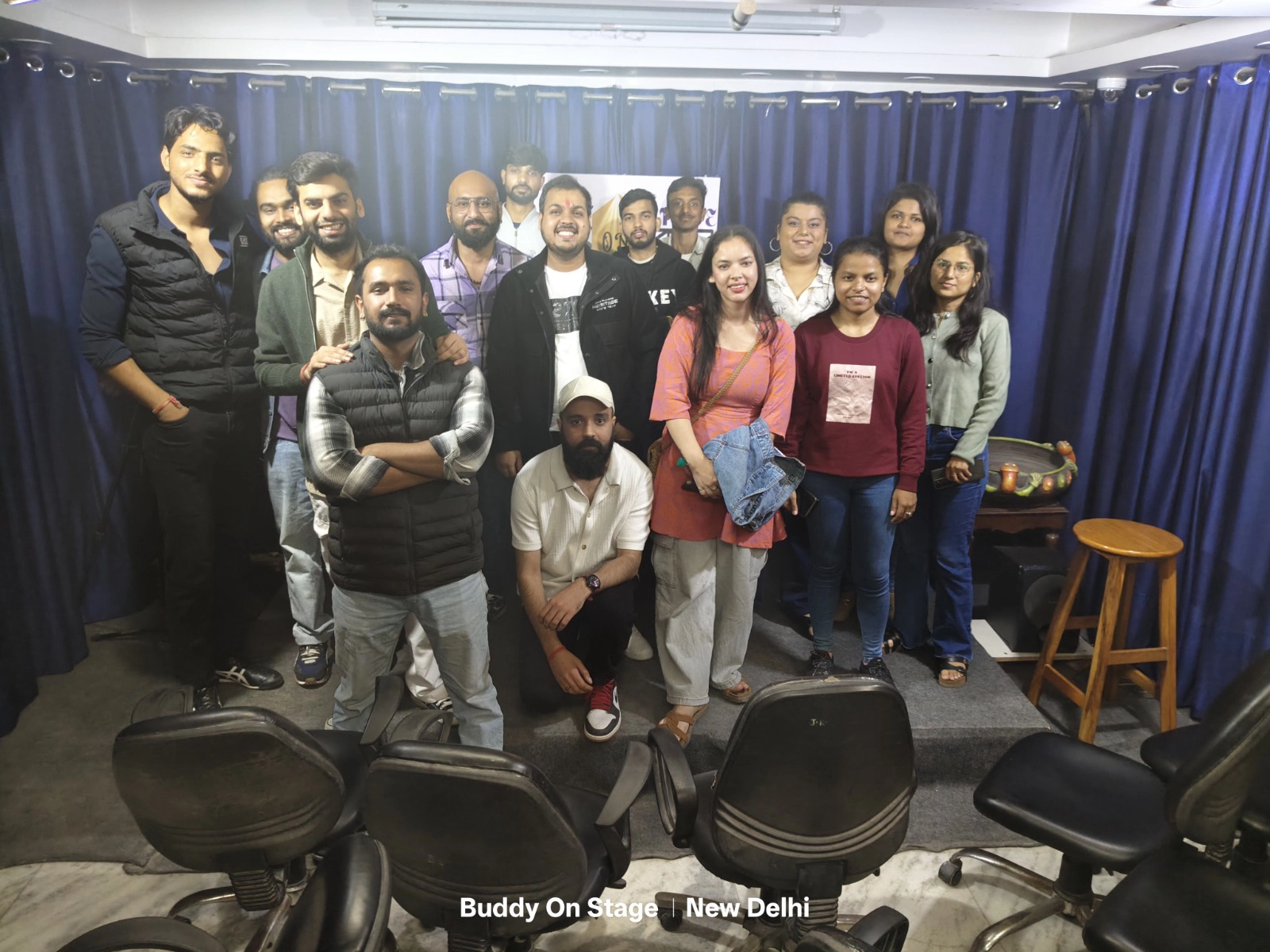
🚀 Practised enough? There's only one way to know if your set works. Put it in front of an audience.
Book Your First Comedy Open MicTest Your Set at an Open Mic
This is the step that separates people who think about doing comedy from people who actually do it.
You've written your jokes. You've structured your set. You've practiced at home. Now it's time to do the thing that no amount of preparation can replace: perform in front of strangers.
Here's what to expect when you book your first comedy open mic at Buddy On Stage:
- The events are affordably priced and run every week in South Delhi. You pick a date, book your slot online, and show up.
- The venue has a proper stage, professional sound, and stage lighting. You'll feel like a real comedian because the environment treats you like one.
- The audience is live, supportive, and there to watch. These aren't distracted diners. They're people who came for the show.
- You get 5 minutes on stage. That's exactly what you've been preparing for.
- Professional video recording is available as an optional but highly recommended add-on. Having footage of your first set is invaluable. You can watch it back to see what worked, what didn't, and what your stage presence actually looks like. Most serious comedians add this to every booking.
When you're on stage, three things will happen that you can't prepare for in your living room:
- Some jokes will hit harder than expected. The joke you almost cut? It might get the biggest laugh of the night. You can't predict what an audience will love.
- Some jokes will fall flat. The joke you thought was your best? Crickets. That's not failure — it's information. Now you know it needs rework.
- You'll discover your stage presence. How you hold the mic, how you move, how you react to laughter and silence — these are things you can only discover in real time, under real lights, with real people watching.
After your set, sit down, breathe, and watch the rest of the show. When you get home, write down everything you remember: which jokes landed, which didn't, where the energy was highest, and what you'd change. This post-show review — combined with your video recording if you opted for it — is the most powerful improvement tool in comedy.
5 Common Mistakes Beginners Make
Every new comedian makes at least one of these. Knowing them in advance gives you an edge.
Starting with a Long Story
You haven't earned the audience's patience yet. If your first joke requires a 45-second setup, you've lost them before the punchline arrives. Open with something quick and punchy. Save the longer bits for after you've established trust.
Explaining the Joke
"Get it? Because...?" is the fastest way to kill a laugh. If the joke lands, the audience gets it. If it doesn't land, explaining it won't help — it just makes the silence worse. Deliver the punchline and move on. Trust the audience.
Speaking Too Fast
Nerves make you rush. You'll speak 30–40% faster on stage than in practice. Consciously slow down. Leave space after punchlines for the audience to laugh. If you barrel through your material at double speed, the audience can't keep up.
Apologizing on Stage
"Sorry, this is my first time" or "I'm not that funny" or "this joke is stupid but..." — don't undermine yourself before you even try. The audience doesn't need a disclaimer. Walk up there like you belong, even if you don't feel it yet.
Waiting Until It's Perfect
Your set will never be perfect. No comedian's set is perfect before they perform it. The stage is where material gets refined. If you keep waiting until every joke is "ready," you'll never perform. Book the open mic. Show up. Do the set. Fix it after.
Frequently Asked Questions
Everything you're wondering about before your first comedy set.
You've Got the Guide. Now Get on Stage.
You can read about comedy forever. But the only way to become a comedian is to stand in front of people and make them laugh. Your first set is written. Your first open mic is waiting. Book your affordably priced spot now.