
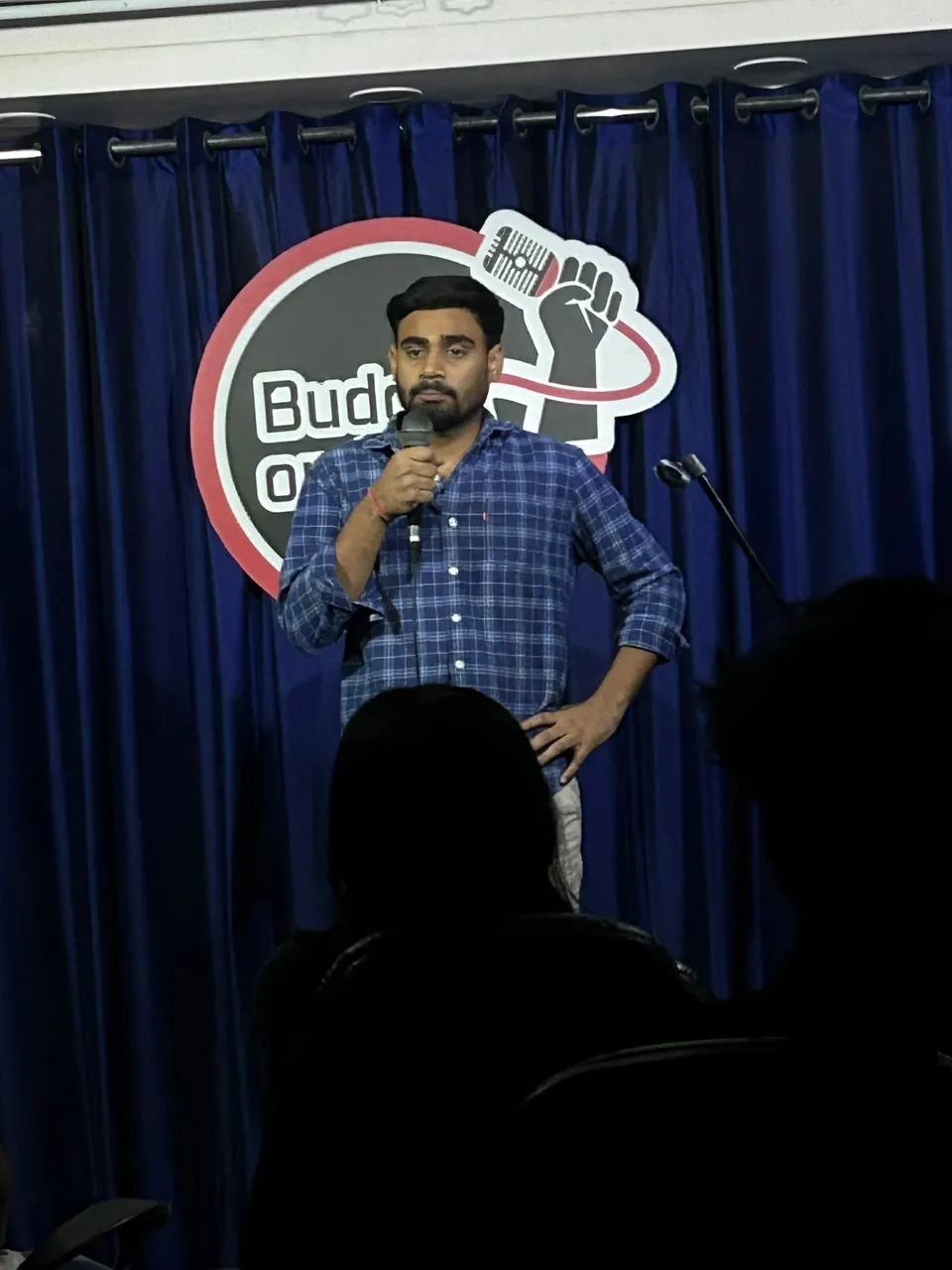
The best way to open a stand-up comedy set is simple: skip the warm-up talk and start with your most reliable short joke, so the room laughs within the first 20 seconds. That first laugh tells the audience “relax, this one is funny” — and every joke after it gets easier.
Most beginners do the opposite. You walk up. You adjust the mic stand for no reason. You say “Hi… kaise ho sab?” The room mumbles something polite. You say “Main thoda nervous hoon.” The room believes you. Forty seconds, zero laughs, and your second joke just became ten times harder. Let us fix that.
Why the Opening of Your Set Matters So Much
An open-mic audience has seen a lot of comics tonight. Some were great, some were… brave. When you walk up, every person in the room is quietly asking one question: “Is this one funny?”
Your first laugh answers it. Once the room laughs, they relax, stop judging and start enjoying. Your weaker jokes get the benefit of the doubt. Without that early laugh, even your best bit has to fight a room that is still sitting with its arms folded.
Think of it like the first ball of a cricket match. A boundary off ball one changes the mood of the stadium. One dot ball is fine. Ten dot balls and the crowd is checking its phone.
Should You Say Hello Before Your First Joke?
“Hello, how is everyone doing?” “Itni garmi hai na aaj?” “So, about me…” None of this is material. It is throat-clearing, and the room can smell it.
At an open mic you might have five or six minutes. Spending thirty seconds on hellos is spending a big slice of your set on nothing. The host already introduced you. Walk up, take the mic, and start with a joke. Politeness can come after the laugh.
The audience does not need you to say hello. They need you to be funny. Say hello with your first punchline.
What Should Your First Joke Be? 3 Openers That Work
1. The Look-Based Self-Observation
The audience is already looking at you and forming opinions. Say the thing they are thinking before they finish thinking it. Your height, your beard, your office-wala shirt, the fact that you look like a CA who wandered in by mistake — acknowledge it and twist it.
“I know what you’re thinking — ye banda pakka kisi ki shaadi mein DJ se gaana change karwata hai. You’re right. And I’ve been thrown out of four.” It works because it is honest, instant and needs zero setup.
2. The Quick Premise
Go straight into your strongest short joke — a setup of one or two lines, then the punch. No “so recently what happened was…”.
“My mom thinks I’m doing comedy as a hobby. She also thinks Wi-Fi is a hobby. Dono ke liye bill main hi bharta hoon.” Your opener is not the place for your ambitious four-minute story. It is the place for your most reliable laugh.
3. The Local Reference
Something everyone in the room shares right now: the venue, the area, the metro ride here, the weather. A quick line about the Delhi traffic you just survived connects you to the room because it is their evening too. One warning: local jokes only work if they are actual jokes. “Malviya Nagar mein parking, haha” is not a joke. It is a sigh.

Find out exactly when your first laugh landed.
Upload your set recording and get timestamped feedback on where the room laughed, where it went quiet, and a concrete fix for your opener.
Analyse My SetHow To Test Your Stand-Up Opener
“I think my opener went okay” is not data. Here is how to know for sure.
- Record every set. Phone on the table near the stage, audience audible. You need the laughs on the recording, not just your voice.
- Note your time-to-first-laugh. Mark the second the first real laugh arrives. Not a polite smile — a laugh you can hear.
- Compare across sets. If the number keeps landing late, the opener is the problem, not the room.
- Change one thing at a time. Cut a line, swap the order, try a different opener type. Then time it again.
You can do this with a notes app and patience. Or upload the recording to Buddy On Stage AI Feedback, which marks where the audience laughed or clapped down to the second and tells you if the opener ran long.
What opener feedback can look like
- [00:00–00:41] Koi laugh nahi — intro aur ‘kaise ho sab’ mein time gaya.
- [00:44] Pehla laugh, ‘CA jaisa dikhta hoon’ line pe — ye line pehle bolo.
- Next set ka focus: intro hatao, seedha look-based line se shuru karo.
Common Mistakes When Opening a Comedy Set
- Apologising: “First time hai, please bear with me.” Now they are nervous for you instead of laughing with you.
- Opening with your best long bit: Long setups need trust you have not earned yet. Save it for the middle.
- Asking the crowd a question: “Kitne log yahan single hain?” Cold rooms do not answer. Now you are improvising a silence.
- Explaining who you are: Your bio is not a premise unless there is a punchline inside it.
- Changing the opener every set: If it got a laugh, keep it until something beats it. Consistency lets you measure.
Pro Tips for a Stronger Opener
- Write five openers, not one. Test them across different mics and keep the winner.
- Memorise the first line cold. Nerves peak in the first ten seconds. Your opener should come out on autopilot.
- Pause after the first punch. Nervous comics rush into the next line and talk over their own laugh.
- Follow the laugh with a tag. A second quick punch on the same idea turns one laugh into momentum.
Final Thoughts
Your opener is a promise: “Relax, I’m funny.” Keep it short, keep it reliable and keep the hellos for after the show.
This week, write three opener options, take one to an open mic, record it, and time your first laugh. Then try to beat that number next week. Twenty seconds is the target. Ten is bragging rights.