
Stage time is irreplaceable — no amount of home practice can substitute for a live audience reacting in real time. But between open mics, home practice is how you sharpen what the stage has already revealed. Skip home work and you show up to each mic with the same rough material. Do it right and every mic becomes a cleaner version of the last.
Here is the solo routine that separates comics who improve fast from comics who plateau at mic #10 and quietly give up by mic #20.
The Daily 20-Minute Routine
Twenty minutes a day beats two hours once a week. The brain consolidates comedy writing better in small, frequent doses than in rare marathons. This is non-negotiable even when you feel uninspired — maybe especially then.
First 5 Minutes: Raw Capture
Open your notes app. Write down 3-5 things from the last 24 hours that made you feel something — annoyance, confusion, amusement, embarrassment. Raw, unedited, as you would text a friend. Do not try to make them funny yet. You are collecting material, not writing jokes.
Examples from a random weekday: neighbour's dog barked through my Zoom meeting, auto guy said meter kharaab hai at the exact same spot for the third time this month, mom sent a 2-minute voice note about nothing. Those three lines are three potential joke premises — all captured in 90 seconds.
Next 10 Minutes: Shape One Idea
Pick one entry from this week's captures — ideally the one that still makes you smile days later. Write it as a joke draft with a clear setup, punchline, and optional tag. Do not polish for perfection; aim for structural completeness instead. You want a full joke, however rough.
The key insight: you cannot iterate on nothing. A rough complete joke is editable. Perfectionism stalls you at fragments. Finish the draft, then return to it tomorrow with fresh eyes.
Final 5 Minutes: Delivery Rep
Stand up. Say your current setlist out loud once, at performance pace. Just one clean pass — no rewinds, no perfectionism, no editing mid-delivery. You are building the muscle memory of performing, not editing the material.
This step is the one beginners skip most often because it feels silly talking to an empty room. Do it anyway. Your voice, breath, and pacing only improve through reps that happen standing, out loud, and timed.

The Weekly 90-Minute Deep Work Session
Once a week, ideally on a consistent day (Sunday evenings work for many), do a longer writing and review block. The daily routine keeps momentum; the weekly session creates real material progress.
- Review the week's 20-25 raw captures. Flag the 3-5 that still resonate. Others go in a quiet archive — not deleted, just parked.
- Shape 2-3 captures into full jokes with tags. Use the setup-punchline-tag structure. Aim for one complete 60-second chunk.
- Integrate new jokes into your running setlist. Do not append to the end — find the logical insertion point based on premise and energy.
- Record a full setlist run-through. Full 6 minutes, standing, phone recording audio only.
- Watch it back with a pen. Mark 3 specific things to fix in next week's daily reps. Not 10 — three is the focused number.
Why The Camera Is Your Best Coach
Nothing reveals your flaws faster or more honestly than watching a recording of your own set. A coach might miss a tic; the camera never does. You will notice filler words you use unconsciously ("so", "like", "basically" every 15 seconds), nervous habits (rocking, mic fidgeting, looking at the floor), jokes you speed through because you are unsure, and moments where your face does not match the emotion your words suggest.
The first 3-4 viewings will be genuinely painful. Watching yourself perform is one of the most cringe experiences in early comedy. Push through anyway — the cringe is not a signal that you are bad; it is a signal that you are seeing what the audience sees, unfiltered, which is exactly the feedback you need.
By the 10th recorded set, you stop cringing and start diagnosing. That shift — from self-critic to self-coach — is one of the clearest markers of growth in a comic's first year.
Home practice only compounds with real mics
Your home reps double in value the moment they are tested in front of strangers. Book your next 6-minute slot at a Buddy On Stage open mic.
Register for an Open Mic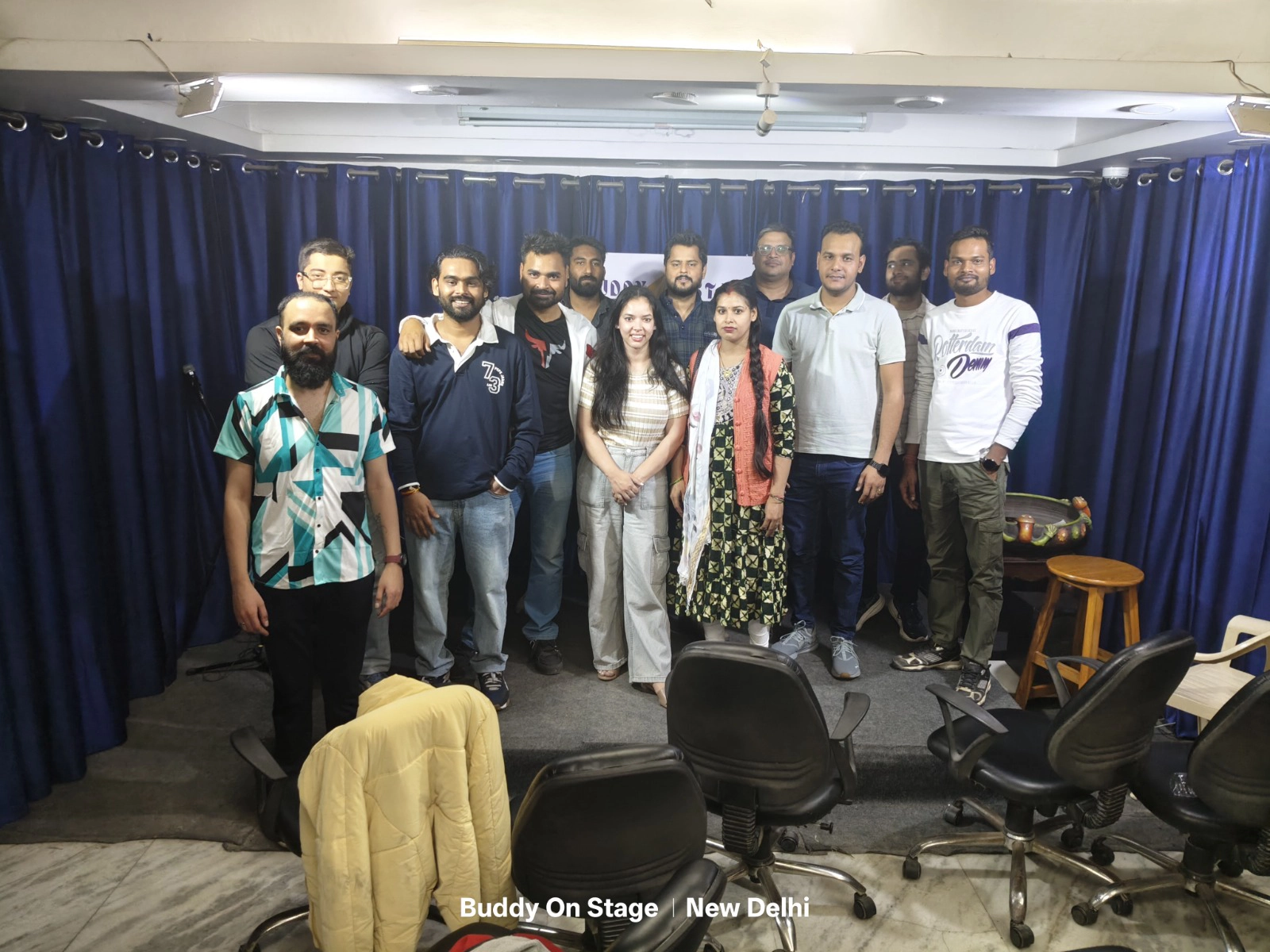
The 5 Biggest Home-Practice Mistakes
- Practising sitting down. The stage is performed standing. Sitting changes your breath, posture, and delivery. Train how you will actually play.
- Skipping vocal warmups. A 60-second warmup — lip rolls, tongue twisters, humming scales — prevents the cracking voice and dry throat that ruin the first 30 seconds on stage.
- Only rehearsing the jokes you love. Rehearse the weak middles twice as much. Those are the passages where you stumble live; the strong jokes take care of themselves.
- Over-rehearsing to flatness. Stop at 20 full passes of the same set. More and the delivery goes robotic — the audience can feel the difference between known and drilled-to-death.
- Not recording. Recording is 80% of the learning. Rehearsing without recording is flying blind; you reinforce flaws without noticing them.
"I used to rehearse by reading through my setlist silently. After I started doing 20 minutes daily standing, out loud, my third set went from 40% laugh rate to 70%. I had been practising wrong for my first two mics."
How Home Practice Connects To Stage Time
Home practice polishes what stage time reveals. Mic night tells you which lines land. Home time lets you rewrite the lines that did not. Neither works alone — but together, they compound. A comic who does both for 12 months is a different creature from one who only performs or only writes.
Practising without performing is like learning to swim on dry land. Performing without practising is like swimming the same stroke forever. The combination is the craft.