

Nobody warns you about the microphone. You spend weeks writing jokes, walk up to your first open mic, and suddenly there is a metal object in your hand and a stand you do not know how to work. Mic fumbling is one of the most common reasons a strong beginner set lands soft — not because the jokes were weak, but because half the room could not hear them.
The fix takes ten minutes to learn and saves you months of muffled sets. Here is everything about handling a mic that no one bothers to explain.
Hold It Close, and Point It at Your Mouth
The single biggest mistake is holding the mic too far away, usually around chest level, because that feels natural in conversation. A stage mic is directional — it only picks up clearly what is pointed straight at it from close range. Keep the top of the mic about a fist’s width from your chin, angled up toward your mouth. Close and consistent beats loud and far every time.
Grip it in the middle of the handle, not over the top (you will muffle it) and not at the very bottom (you will angle it away from your mouth). Relaxed, firm, middle. That is the whole grip.
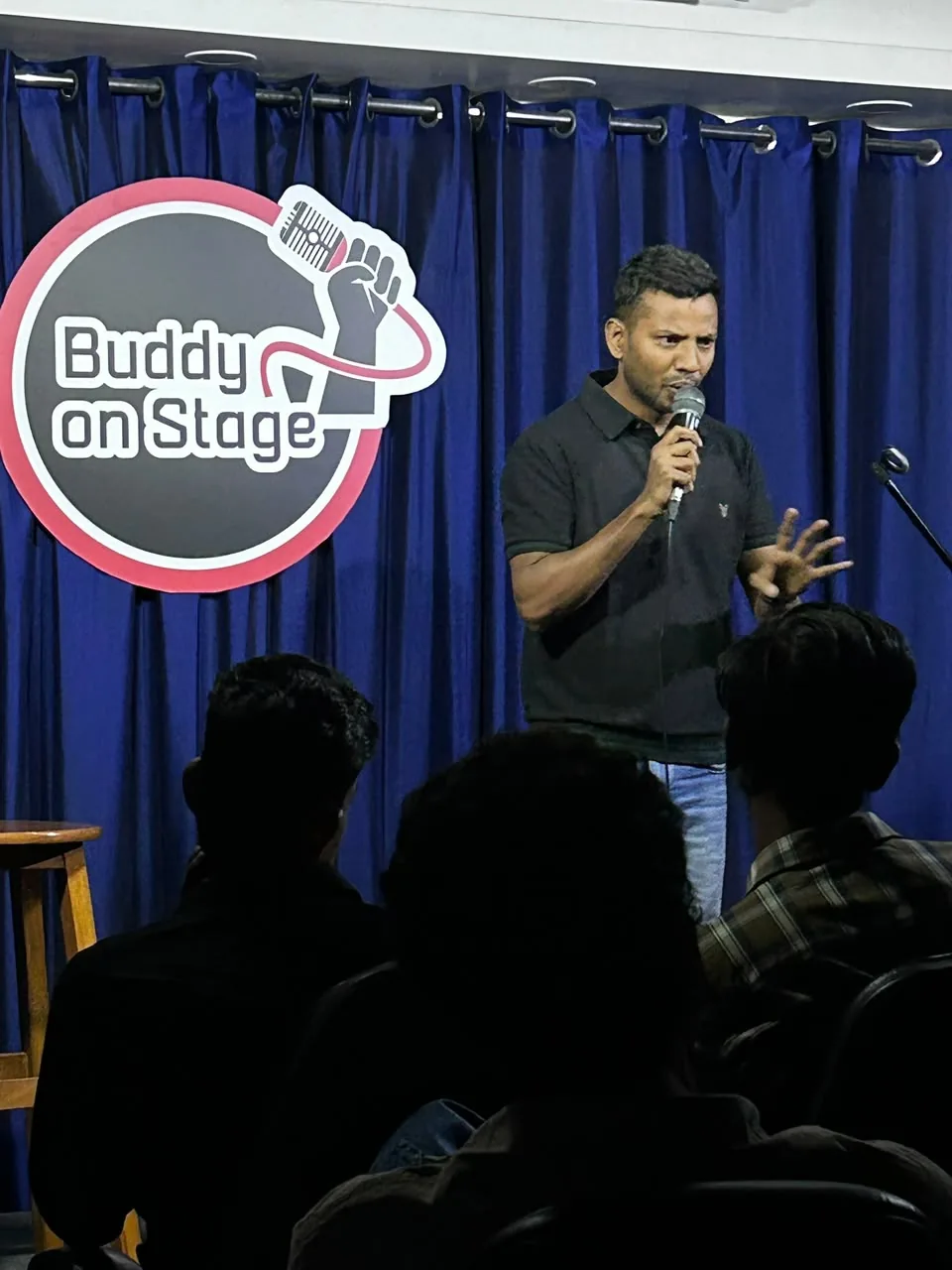
How To Take the Mic Off the Stand (Without the Fumble)
Most beginners freeze at this exact moment. Practise it so it becomes automatic:
- Before you speak, lift the mic straight up and out of the clip with one hand.
- Move the stand aside with the other hand so it is not between you and the audience.
- Then start talking. Do not try to do all three at once while delivering your opener.
Some comics prefer to leave the mic in the stand and perform hands-free, which is totally fine and frees up both hands for act-outs. If you do, adjust the stand height first so the mic sits at chin level.
Watch the Distance When You Get Loud
When you shout a punchline or do a loud act-out, instinct makes you push the mic closer — which causes distortion and that harsh popping sound. Do the opposite: pull the mic slightly away as you get louder, and bring it back in for quieter, intimate lines. Good mic control is a volume dial you operate with your arm.
Mic skills only become automatic with reps.
You cannot learn mic feel from an article alone — you learn it by holding a live mic in front of a real room. Book 6 minutes and get the reps.
Register for an Open MicAvoid the Popping and Feedback
- Popping (harsh bursts on P and B sounds) happens when you speak straight into the mic head from point-blank range. Angle it just slightly across your lips rather than dead-on.
- Feedback (that screech) happens when the mic points at the speakers. Keep the mic pointed at you, and do not walk in front of the stage monitors.
- Cupping the head of the mic with your hand looks cool and ruins the sound instantly. Never do it.
Do a Two-Second Check When You Start
Your first line out loud is also your sound check. Say your opener and glance at the back of the room — are they leaning in or straining? If the host or audience signals they cannot hear, simply bring the mic closer and project. No shame in it; even pros adjust in the first few seconds.
The audience cannot laugh at what they cannot hear. Mic technique is not a detail — it is the difference between a set and a mime act.
Get Comfortable With It On Stage
Reading about mic technique is like reading about swimming. The feel only comes from holding a real mic, in a real room, through a real set. The first time it stops feeling awkward is usually around your third or fourth open mic. Book one, focus purely on staying audible, and let the jokes take care of themselves once the room can hear you.