
It is a question almost every Indian poet wrestles with: should I write and perform in Hindi, Urdu, English — or the Hinglish I actually speak? There is a quiet pressure in both directions. English can feel more “serious” or shareable; Hindi and Urdu can feel more “authentic” or rooted. Both pressures are misleading. Here is a clearer way to decide.
The short version: perform in the language your feeling arrives in. The longer version is worth reading, because the choice shapes how your poem lands in the room.
Write In the Language You Feel In
Your first question is not “which language sounds more impressive” but “which language did this feeling come to me in?” If you fought with your mother in Hindi, the poem about it probably wants to be in Hindi. If your heartbreak played out over English texts, English may carry it truest. Emotion has a native tongue, and forcing a poem into a language it was not felt in usually drains its life. Follow the feeling, not the prestige.
There Is No 'Serious' Language
Kill this myth early: English is not more literary and Hindi-Urdu is not more soulful. Every language has produced staggering poetry and cheap greeting-card verse alike. Faiz and Frost are both giants; a bad poem is bad in any tongue. Audiences do not award points for language — they respond to truth, image and rhythm, all of which exist everywhere. Choose the language that lets your poem be its most honest, not the one you think earns respect.
Hinglish Is a Real Poetic Language
For a huge number of young Indians, the honest answer is: I do not think in one language. You think in Hinglish — sliding between Hindi and English mid-sentence the way you actually talk. That is not a compromise or a lack of vocabulary; it is a genuine, expressive poetic register, and it is exactly how your generation lives. Poems that code-switch can hit twice as hard because they sound like real life. Do not sanitise your poem into one language to seem more legitimate. Hinglish is legitimate.
Consider the Room — a Little
Language also affects reach. In a mixed Delhi open mic, Hindi, Urdu, English and Hinglish all land, because the audience is bilingual and follows feeling across tongues. If you know a particular room skews heavily one way, you can factor that in — but never at the cost of the poem’s honesty. A true poem in your natural language beats a diluted poem in the “strategic” one. Awareness is useful; self-erasure is not.
- Mixed / bilingual room (most Delhi mics): any language works; perform in your natural one.
- Heavily Hindi/Urdu crowd: nazm, ghazal and shayari will resonate deeply.
- English-leaning cafe crowd: English and Hinglish spoken word fit naturally.
- Unsure? Trust the language the poem was born in — it is the safest bet.
The only way to hear which language lands is to read it aloud to a room.
Bring your poem in whatever tongue it was born in and let a live audience respond. Book a slot at a language-friendly open mic.
Register for an Open MicMind the Craft of Each Language
One practical note: each tradition has its own music. Urdu shayari leans on radeef and qaafiya — the repeating end-word and rhyme the mehfil waits for. Hindi nazm has its own rhythm and imagery. English spoken word has its cadences and enjambment. Perform in the language whose music you can actually hear and handle, so you are playing to your strength rather than fighting an unfamiliar form. Your ear in that language is part of your craft.
You Are Allowed To Perform In More Than One
This is not a lifelong vow. Many poets perform a Hindi piece one week and an English one the next, or blend both in a single poem. Your language is a palette, not a cage. Over time you will discover which themes pull you toward which tongue — grief in one, humour in another, home in a third. Let that map itself naturally across many mics instead of deciding your “brand” on day one.
Do not ask which language is more respected. Ask which language is more true for this poem. The audience can always tell the difference, even across a language they barely speak.
Pick the Honest One, Then Go Read It
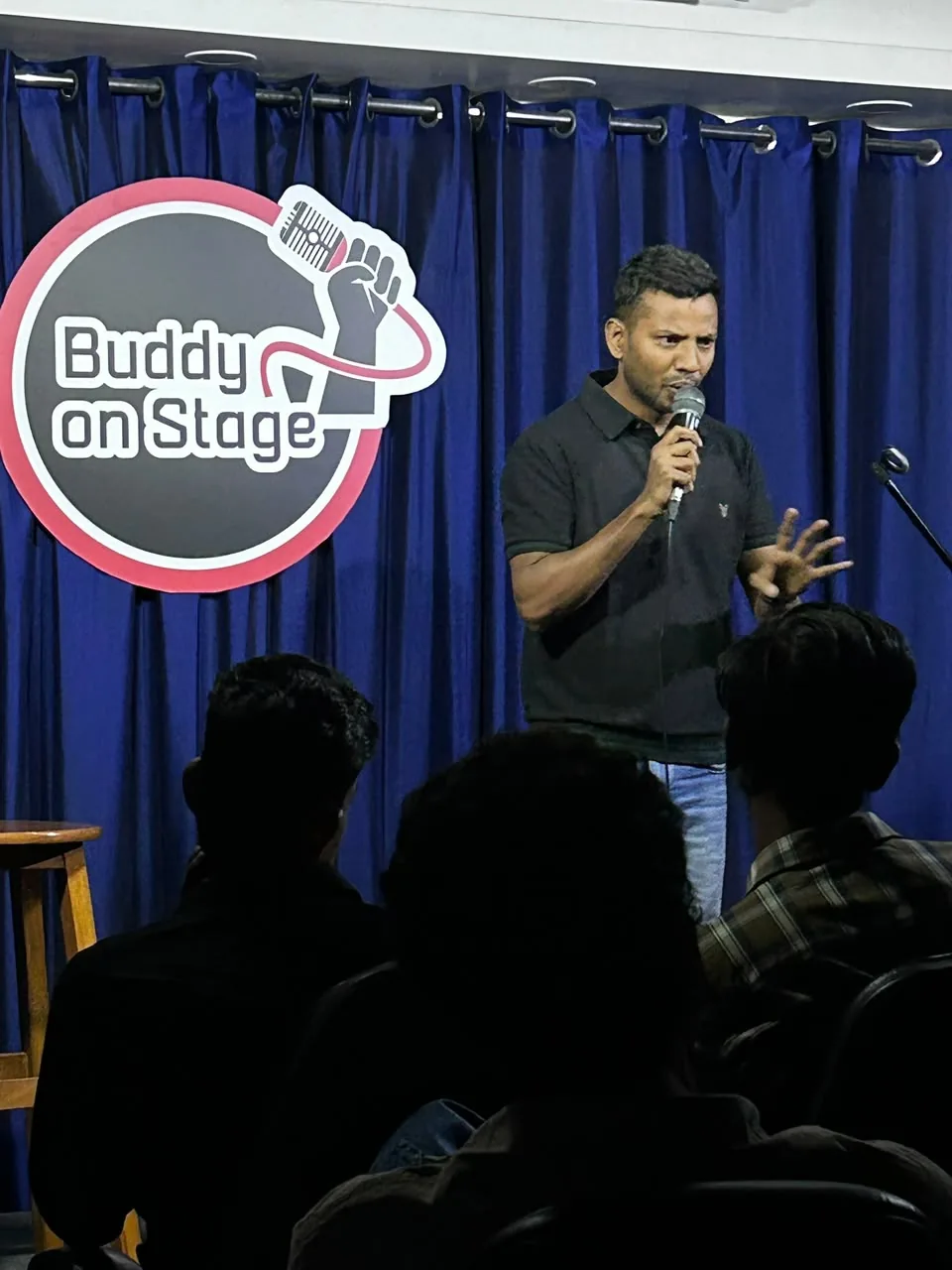
Choose the language your feeling arrived in, respect the music of that tradition, and do not shrink your natural Hinglish to seem more serious. Then do the only thing that actually settles the question — read the poem aloud to a real room and feel it land. Buddy On Stage runs weekly open mics in New Delhi where Hindi, Urdu, English and Hinglish all share the same welcoming mic. Bring your poem in its truest language and perform it.