
Search for ways to entertain office staff and you get the same seventeen results wearing different headlines. Cake-cutting. Potluck. Secret Santa. Tug of war in the parking lot. Housie on a projector. They are not bad ideas. They are just the ideas every office has already used, which means your team can predict the entire afternoon from the calendar invite — and a predictable afternoon is not entertainment, it is a meeting with snacks.
This list is sorted differently. Not by cost, not by team size, but by how much work it takes from you, because that is the variable that actually decides whether an idea survives past the planning stage. Everything in the first group you can run this week with nothing but a calendar invite. Everything in the last group needs a booking and a budget, and does something the first group cannot.
The one test that predicts whether anyone shows up
Before the list, the filter. Ask yourself a single question about any activity you are considering: if attendance were genuinely optional and nobody tracked who came, would people still come?
That question kills about half of what normally gets planned. Mandatory fun is not fun; it is unpaid overtime with a theme. The activities that pass this test share three traits. They have a clear end time, so nobody is trapped. They do not require anyone to perform in front of colleagues unless they volunteer. And they give the quiet people something to do other than stand in a circle holding a paper plate.
Mandatory fun is not fun. It is unpaid overtime with a theme. Design for the person who would rather be at their desk, and everyone else is already covered.
Group 1: Zero budget, run it this week
These cost nothing but a calendar block. Their job is rhythm, not spectacle — small, frequent things that keep a floor feeling alive between the bigger events.
- Desk swap Friday. Everyone moves one desk to the left for a day. It sounds trivial. It is the fastest way to make two people who have worked in the same room for a year actually speak to each other.
- The two-minute show-and-tell. Open one weekly meeting with a single person showing something they made, cooked, fixed or photographed outside work. Strict two minutes. The strictness is what makes it work — nobody has to prepare.
- Guess the baby photo. Ancient, still undefeated, and one of the few games where senior leadership being in it is the whole joke.
- Mystery lunch roulette. Randomly pair four people who do not work together and cover their lunch. No agenda, no reporting back. The absence of an agenda is the point.
- Office playlist wars. Each team gets a week to own the floor's music. Ends in a vote. Costs nothing, generates a month of arguments in the best way.
- The wall of small wins. A physical whiteboard where anyone can write a thing that went right this week, including tiny things. Recognition that does not need a form, an approval or a manager.
None of these will show up in an engagement survey on their own. What they do is lower the social temperature of the floor so that when something bigger happens, people are already warmed up to each other instead of standing in departmental clumps.
Group 2: A little effort, a lot more payoff
These need someone to organise them, but no external booking. Budget a couple of hours of your time and, at most, the cost of snacks.
- An in-house skills exchange. Somebody in your office can teach guitar, Excel that actually works, basic Photoshop, home baking or how to change a tyre. Forty-five minutes, volunteers only. Watching a junior teach a director something is worth the whole afternoon.
- The office roast (carefully framed). Not people — processes. Each team gets five minutes to roast the most annoying internal process they deal with, and the leadership team has to sit and take it. Enormously funny, and you will get better operational feedback than from any survey.
- Blind taste test, office edition. Chai from four different vendors near the building. Strong opinions appear within ninety seconds. Absurdly cheap.
- A photo hunt across the building. Cryptic clues, mixed teams, thirty minutes, phones only. It gets people physically out of their chairs, which most office activities quietly fail to do.
- Reverse mentoring hour. The newest joiner runs a session for the oldest. Genuinely useful, and it flips the room's status order for an hour, which is healthier than it sounds.
Want the bigger version without the planning?
Tell us your headcount, city and office setup. We will send back what a monthly live session looks like for a team your size in Delhi NCR - what runs, who runs it, and what is included in one price.
See Engagement PlansGroup 3: Bring in a live act — the ones people talk about for weeks
Here is the honest difference between the first two groups and this one. In-house activities are run by colleagues, which means somebody your team works with is standing at the front trying to generate energy in a room that knows them. That is a hard job, and it is why the same four enthusiastic people end up running everything until they burn out.
A live act changes the physics of the room. The performer is an outsider, so nobody has to manage their own workplace image while watching. There is a defined start and end. And critically, your HR team gets to be in the audience instead of running the show — which is the single most underrated benefit of booking rather than organising.
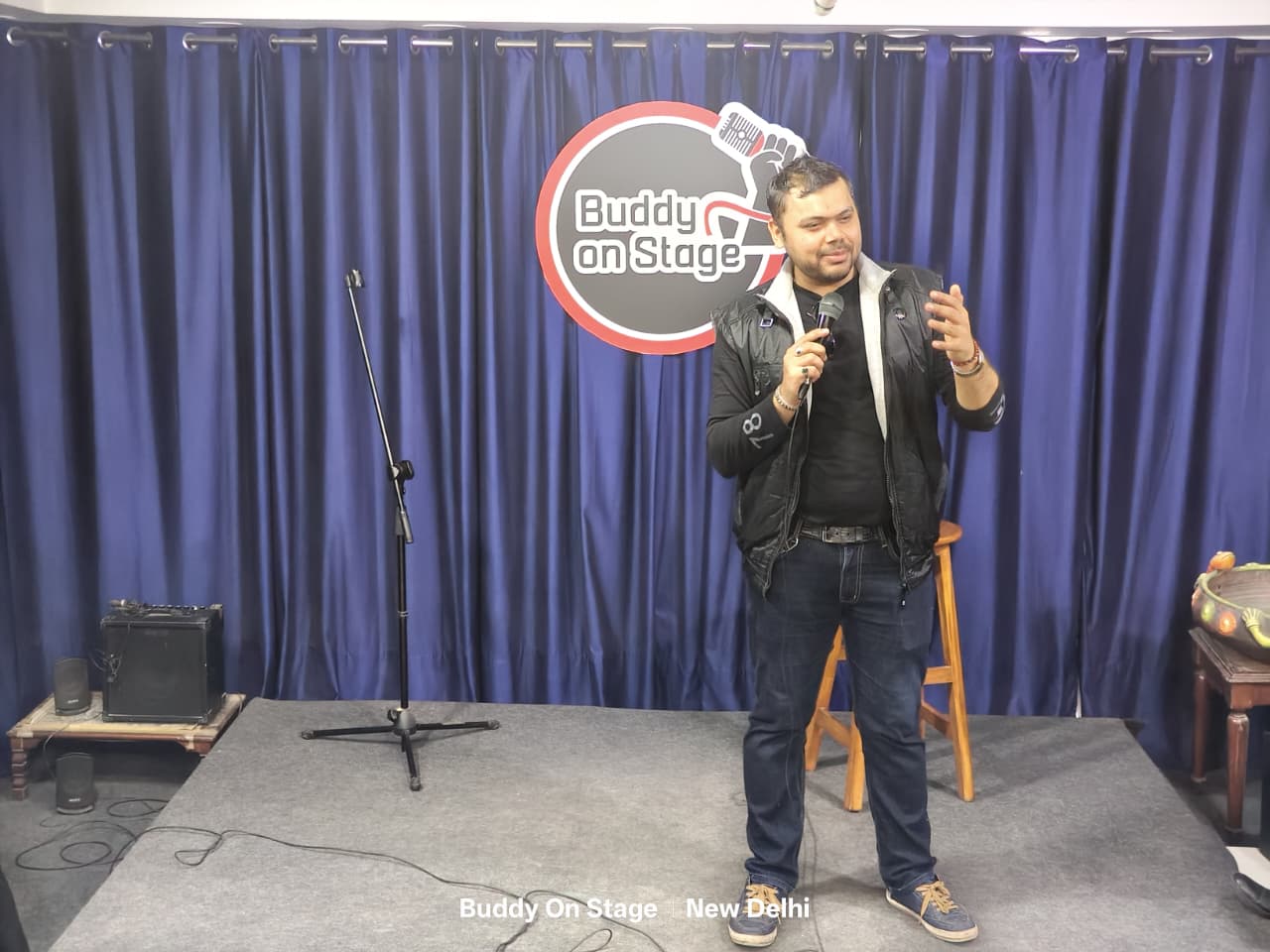
- Stand-up comedy at the office. The format that converts a conference room into a room fastest. Forty-five minutes, clean workplace-appropriate material agreed in advance, and the whole floor laughing at the same thing at the same time. You can browse verified stand-up comedians and read their style, languages and experience before you shortlist.
- Close-up magic that moves desk to desk. Perfect when you cannot stop the whole floor at once. The magician works table to table for ninety minutes; nobody has to attend anything, and everyone gets a two-minute personal show.
- A live acoustic set at 5pm. Not a DJ, not a party — one singer with a guitar in the cafeteria as the day winds down. It is the least disruptive live format there is and it changes the entire feeling of a Friday evening.
- Host-led interactive games. The difference between an HR-run quiz and a professionally hosted one is roughly the difference between a school assembly and a game show. A good host keeps the energy up, manages the quiet tables, and does not let the loud team run away with it.
- A poetry and spoken-word evening. Underrated for offices with a genuinely mixed crowd — it lands in Hindi, English and Hinglish, it is quieter than comedy, and it works in a room where you do not want anything rowdy.
- Mentalism or a mind-reading act. The rare format where the cynical senior manager in the corner is the most engaged person in the room by minute five.
How the funny, creative and unique versions actually differ
People search for funny ways, creative ways and unique ways to entertain office staff as if they were three different problems. They are the same problem with three different failure modes.
- Funny fails when the humour is generated by employees at each other's expense. Bring humour in from outside — a professional whose job is being funny about shared experience rather than about a specific colleague.
- Creative fails when creativity is mandatory. Nobody wants to paint a canvas under observation by their appraiser. Make every creative activity opt-in and give the opt-outs somewhere to be.
- Unique fails when unique means complicated. The most memorable thing you can do is usually a familiar format executed properly — a real comedian instead of the funny guy from Sales, a real host instead of a manager with a microphone.
The rhythm matters more than the list
You could run every idea on this page and still have a flat office, because entertainment delivered once a year in December is not a culture, it is an event. The companies where this actually works do something small most weeks and something real every month.
That monthly slot is the one people plan around. It is why our employee engagement programme is built as a monthly rhythm rather than a one-off — one, two or four sessions a month, a different art form each time, performer and host and sound and games in one price, no lock-in. If you would rather book a single act for one occasion instead, that is what the artist directory is for.
Whichever route you pick, pick the rhythm first and the activities second. A mediocre activity on a reliable schedule beats a brilliant one nobody expects again. If you want the month-by-month version, we wrote it up in our 12-month engagement calendar.