
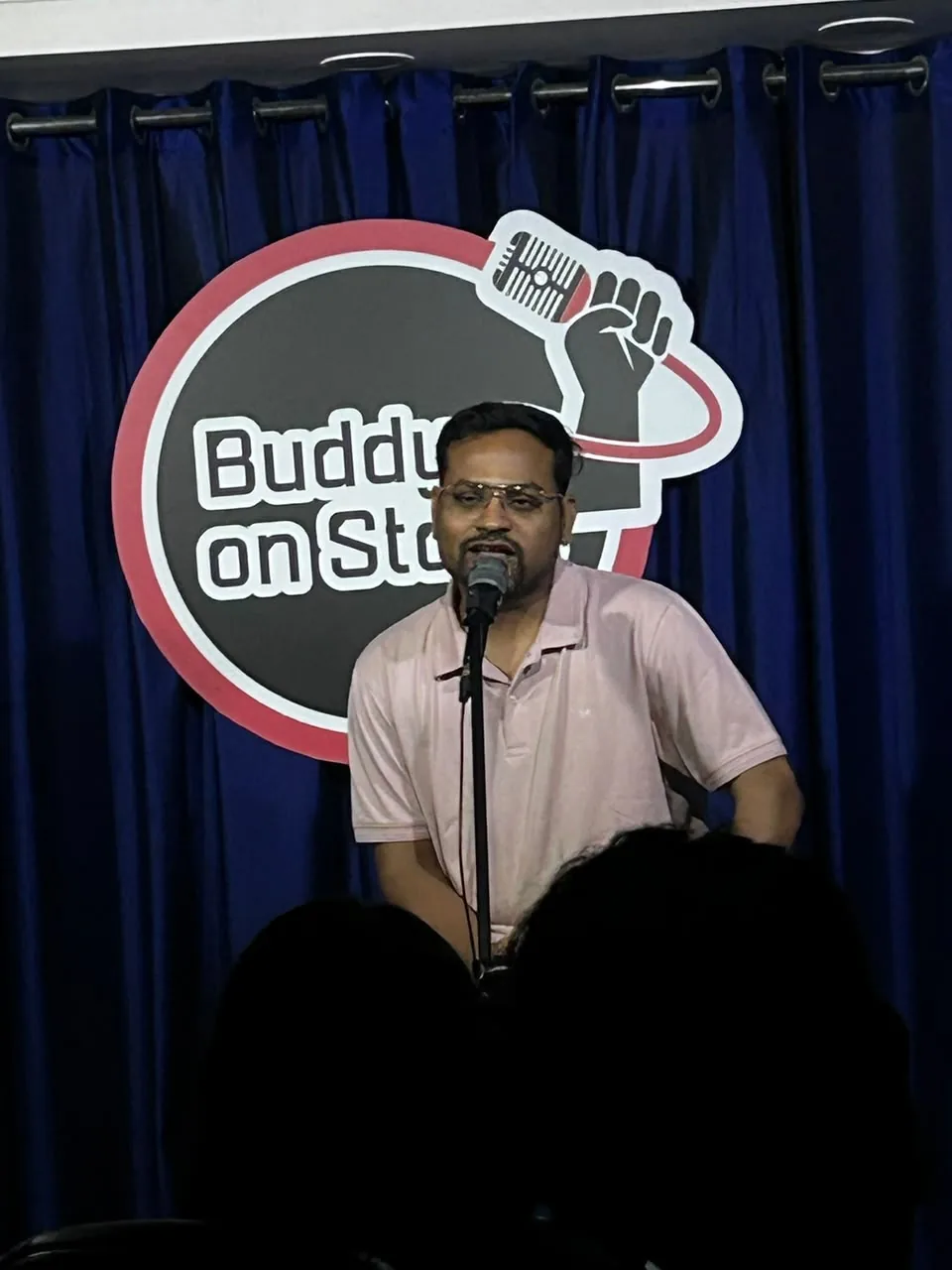
Stand-up comedy is a live performance where one comedian stands in front of an audience and speaks directly to them, using their own material to make the room laugh. No costume change, no co-actor, no laugh track, no second take. Just a person, a microphone and a crowd that will tell you, within seconds, whether your joke is funny.
That simplicity is exactly why it is so hard — and so addictive. Let us break down what stand-up actually is, how a set is built, how it differs from its comedy cousins, and why the live room is the entire point.
What Does Stand-Up Comedy Mean?
Strip it down and every stand-up performance has the same five ingredients:
- One performer: you carry the whole show. Nobody else to blame, nobody else to share the applause with.
- A mic: the most honest prop in entertainment. It amplifies your jokes and your nerves equally.
- Direct address: you talk to the audience, not in front of them. There is no fourth wall to hide behind.
- A live audience: real people reacting in real time. Their laugh, or their silence, is part of the act.
- Your own material: stand-up comics are expected to write what they perform. Reciting someone else’s jokes is the fastest way to lose a room’s respect.
The name is literal: the comic usually stands, up, in front of everyone. Some sit on a stool. The spirit is the same — one human, fully exposed, trying to turn their view of the world into laughter.
How Is Stand-Up Different From Sketch, Improv and Sitcom?
People often lump all comedy together, but the formats are very different animals:
- Sketch comedy: short scripted scenes, usually with several actors playing characters. Rehearsed, often filmed, and the audience watches a story rather than being spoken to.
- Improv: scenes made up on the spot from audience suggestions, usually by a team. Nothing is written in advance; the fun is in the invention.
- Sitcom: a scripted series with recurring characters, a writers’ room, multiple takes and an edit.
- Stand-up: written and polished material, performed solo, as yourself, directly to the room. Rehearsed, but alive enough to bend when the room bends.
In other words, an improviser builds the house during the show, a sketch actor lives in a house someone else designed, and a stand-up comic builds the house at home, then gives the audience a guided tour — adjusting the route depending on who is on the tour.

What Is the Structure of a Stand-Up Comedy Set?
A set is not just a pile of jokes. A good one has a shape:
- The opener: a quick, reliable joke that earns the first laugh early and tells the room “relax, this person is funny.”
- The bits: chunks of material on one topic — your landlord, your Bengali mother-in-law, the Delhi Metro at 9am. Each bit has setups, punchlines and often tags (extra punchlines with no new setup).
- The transitions: how you move from bit to bit without the room feeling the gear change.
- Callbacks: a reference to an earlier joke later in the set, which usually gets a bigger laugh because the audience feels like an insider.
- The closer: your strongest bit, saved for last, so you leave the stage on the loudest laugh rather than a polite clap.
If you want to go deeper into the building blocks, our guides to joke structure and callbacks break each one down with examples.
Curious what it feels like from the other side of the mic?
Reading about stand-up is like reading about swimming. Book a beginner-friendly 6-minute slot — no audition, open mics every week without skip.
Book My Open Mic SlotWhat Are the Different Formats of Stand-Up?
- Open mic: short slots for anyone who signs up. This is where jokes are born, tested and, frequently, buried.
- Club spot: a booked slot in a proper comedy show, usually with tested material.
- Hosting: the emcee warms up the room, introduces comics and keeps the energy steady between acts.
- Special: a long, polished hour, often recorded and released on video — usually the result of years of open mics.
- Crowd work: not a format so much as a skill — chatting with the audience and finding the comedy live, in the moment.
Why Is the Live Audience the Whole Point?
A joke in your notes app is a theory. A joke said to fifty strangers is an experiment with results. The audience decides the punchline’s fate, the timing of your pauses and even which bits survive. That is why every comic you admire spent years doing short sets in small rooms — the room is the editor, the teacher and the exam paper all at once.
The tricky part is that, in the moment, you cannot remember what the room did. Adrenaline wipes the memory. This is why comics record their sets and listen back. If you already perform, you can upload that recording to Buddy On Stage AI feedback and see where the audience laughed or clapped, where it went quiet, and one clear thing to work on next — on WhatsApp and email, in Hindi, Hinglish or English.
Already doing stand-up? Find out what your room was really telling you.
Upload a recording of your set and get timestamped feedback on laughs, quiet stretches, pace and one focus for your next set. No login, and you see the exact price before you pay.
Get AI Feedback on My SetCommon Myths About Stand-Up Comedy
- “Comics just make it up on stage.” Most of a set is written, rewritten and tested dozens of times. It only looks spontaneous.
- “You have to be the funny one in your friend group.” Being funny at a party and being funny to strangers are different skills. The second is learned.
- “Stand-up is only about jokes.” It is about a point of view. Jokes are just how you deliver it.
Final Thoughts
Stand-up comedy is the simplest format in entertainment and the hardest to fake: one person, one mic, one honest room. Everything else — structure, timing, callbacks, crowd work — is built on top of that brave, slightly ridiculous act of standing up and talking.
If any part of you has wondered what it feels like, book an open mic. Six minutes. A friendly room. The fastest way to understand stand-up is to stand up.