
Delhi has been a city of poets for centuries. From the courtly mushairas of Mughal emperors to the revolutionary verses of the freedom struggle, from Mirza Ghalib's haveli in Old Delhi to the chai stalls of JNU where students still argue about chhayavaad versus pragativaad — poetry runs through this city's bloodstream in a way that no other Indian metropolis can claim.
Today, that ancient tradition has found a new home: the Hindi poetry open mic. Every week, dozens of events across Delhi NCR give poets a microphone, a spotlight, and five minutes to share their shayari, kavita, ghazal, or spoken word with a live audience. Whether you write in pure Hindi, Urdu, Hinglish, or something entirely your own, there is a stage waiting for you in this city.
This guide covers everything you need to know — the types of Hindi poetry you can perform, the best venues and platforms, practical tips for delivering your work on stage, and how to grow from a bedroom poet into a confident performer. If you have ever written a sher in your notes app and wondered what it would feel like to speak it aloud to a room full of strangers, this article is for you.
The Rise of Hindi Spoken Word in Delhi
For a long time, the Indian spoken word scene was dominated by English. The earliest poetry open mics in Delhi — around 2012 to 2016 — were overwhelmingly English-language affairs, modeled on Western slam poetry traditions. Performers drew inspiration from American poets like Sarah Kay and Neil Hilborn, and the content often mirrored themes popular in English-language spoken word globally: identity, heartbreak, social justice.
Hindi poets existed in this era too, but they performed mostly in university settings — DU literary societies, JNU cultural events, Jamia poetry circles. These were closed communities. If you were not a student at the right college or part of the right WhatsApp group, you probably never knew these events existed.
The shift began around 2017-2018 when Instagram became the dominant social media platform for young Indians. Hindi poetry accounts started gaining massive followings — far larger than their English counterparts. Accounts posting two-line shayari on minimalist backgrounds were reaching millions. Suddenly, the market signal was unmistakable: Hindi poetry had a much larger audience than English poetry in India. It was not even close.
Open mic organizers noticed. Events that had been English-only started adding Hindi slots. Then bilingual events appeared. Then fully Hindi open mics launched in neighborhoods like Lajpat Nagar, Saket, Rajouri Garden, and North Campus — areas where the audience was more comfortable in Hindi than English. The pandemic accelerated this further: Zoom and Instagram Live open mics erased geographic barriers and brought performers from Hindi-medium backgrounds who had never attended an event at a South Delhi cafe.
Hindi has become the dominant language at poetry open mics in Delhi. English-only events still exist, but they are the minority. The city's poetry scene now reflects what anyone who lives here already knows — Delhi thinks, feels, and argues in Hindi. It was only a matter of time before its stages caught up. New to the concept of poetry open mics? Start with our complete guide to poetry open mics in Delhi.
Types of Hindi Poetry You Can Perform at Open Mics
One of the beautiful things about Hindi poetry open mics in Delhi is the sheer range of forms that are welcomed on stage. Unlike a traditional mushaira where you might be expected to stick to classical meter, or a Western slam where contemporary free verse is the norm, a Delhi open mic embraces everything. Here are the major forms you will encounter.
Shayari
Shayari is the most popular form at Delhi open mics by a significant margin. Rooted in the Urdu poetic tradition, shayari encompasses sher (couplets), rubaiyat (quatrains), and longer forms. What makes it so suited to open mics is its density — a single sher can carry an entire emotional payload in just two lines. A performer can deliver five or six independent shers in a three-minute slot, each one a self-contained piece that either lands with the audience or does not. The feedback is immediate and honest.
Modern shayari at Delhi open mics spans the full emotional spectrum — ishq (love), dard (pain), siyasat (politics), falsafa (philosophy), and humor. The most effective performers blend classical vocabulary with contemporary references, creating work that feels both timeless and immediate.
Kavita
Kavita — Hindi poetry in the broader sense — covers everything from structured verse to free-form pieces. This is where you hear the influence of the Hindi literary tradition: chhayavaad (romanticism), pragativaad (progressive realism), prayogvaad (experimentalism). At open mics, kavita tends to be longer than shayari — typically one or two poems filling a five-minute slot rather than a series of standalone couplets.
The subjects are as broad as life itself. Performers write about their mothers' kitchens, Delhi's pollution, the pain of unrequited love, the absurdity of corporate life, caste oppression, gender violence, and the experience of being young in a rapidly changing country. Kavita is where Hindi spoken word comes closest to storytelling — the best performers create vivid scenes and take the audience on a journey rather than delivering standalone lines.
Ghazal
The ghazal is one of the most demanding poetic forms to perform well. A sequence of couplets sharing the same meter and rhyme scheme (radif and qaafiya), the ghazal requires technical precision alongside emotional depth. At Delhi open mics, ghazal performers are often the most experienced poets in the room — they have spent years learning the craft, and it shows.
What makes a live ghazal performance special is the audience interaction. In the mushaira tradition, listeners respond to each couplet with "wah wah" or ask for a repeat by calling "irshad." At open mics, this tradition persists in a more informal way — you will hear murmurs of appreciation, spontaneous applause after a particularly strong sher, and the occasional "ek aur" (one more) when the poet finishes.
Nazm
Where a ghazal is a collection of thematically independent couplets, a nazm is a unified poem with a single theme running through it. Nazm gives the poet more narrative freedom — you can build an argument, tell a story, or explore an idea from multiple angles. For open mic performers who want to make a point or share an experience, nazm is often the most effective form because it allows for a clear beginning, middle, and end.
Contemporary Hindi Spoken Word
This is the form that has grown fastest in the last five years. Contemporary Hindi spoken word draws from all the traditional forms above but adds elements borrowed from Western slam poetry — performance techniques like repetition, building intensity, breaking the fourth wall, and using rhythm and pace as emotional tools. The content is often overtly personal or political, and the delivery is energetic and theatrical.
If you watch Hindi spoken word clips on Instagram or YouTube, this is what you are seeing. Performers like Priya Malik, Nidhi Narwal, and Yahya Bootwala brought this form into the mainstream, and a new generation of Delhi poets is building on their foundation. At open mics, contemporary spoken word is particularly popular with performers under 25 who grew up watching these videos.
Hinglish Poetry
Hinglish — the fluid mix of Hindi and English that most young Delhiites actually speak — has become a legitimate poetic language in its own right. At open mics, Hinglish performances feel natural and authentic because they mirror how the audience actually thinks and talks. A poet might start a line in English and complete the thought in Hindi, or weave English phrases into an otherwise Hindi piece.
The advantage of Hinglish at open mics is accessibility. It reaches both the crowd that is comfortable in English and the crowd that connects more deeply with Hindi, without excluding either. For performers who are not confident enough in pure Hindi or pure English to fill a five-minute slot, Hinglish is a welcoming middle ground that audiences respond to enthusiastically.
Best Open Mics for Hindi Poets in Delhi
Delhi offers a wide range of open mic formats, and Hindi poets can thrive in many of them. Multi-genre events are especially exciting because your shayari or kavita reaches listeners who came for comedy or music — and the emotional contrast makes your poetry land even harder. For a comprehensive area-by-area breakdown, see our guide to the best open mic venues for poets in Delhi NCR. Here are the types of events and venues where Hindi poets do their best work in Delhi.
Dedicated Poetry Open Mics
These are events specifically designed for poets. The audience comes to listen to poetry, the host understands poetic forms, and the environment is set up for attentive listening — proper sound, controlled lighting, and a culture of respect for the performer. Dedicated poetry open mics happen regularly in college areas (North Campus, South Campus) and in cultural spaces across South and Central Delhi.
Multi-Genre Open Mics
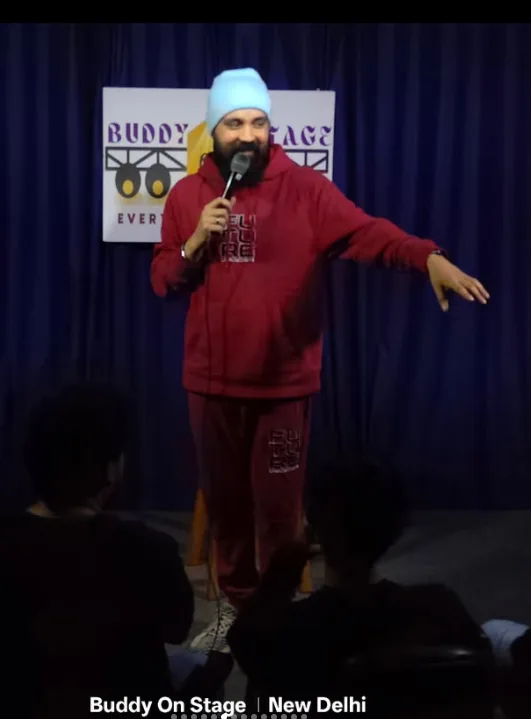
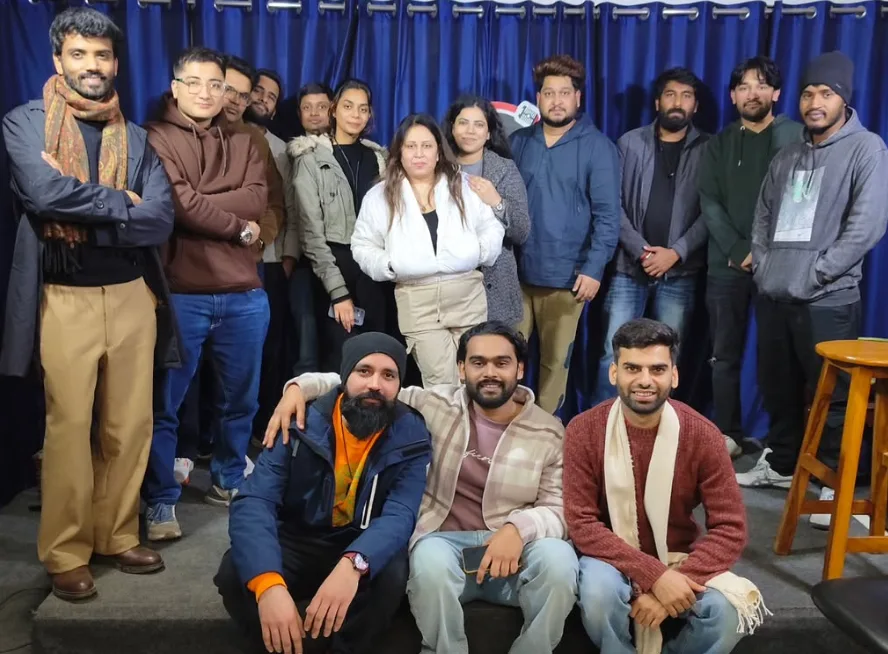
Multi-genre events — where poetry shares the stage with comedy, singing, rap, and storytelling — are some of the best environments for Hindi poets, especially beginners. Buddy On Stage in Malviya Nagar is a prime example. Their weekly events welcome performers across all art forms and all languages, including Hindi, Urdu, Hinglish, and English. The advantage of a multi-genre platform is exposure: your poetry reaches people who came to hear comedy or music and discover that they love spoken word. Many Hindi poets who perform regularly at Buddy On Stage events describe it as the most supportive stage in Delhi for first-timers — the audience is warm, the host provides constructive feedback, and the sound setup ensures your words are actually heard clearly.
College and University Events
Delhi's universities are hotbeds for Hindi poetry. Cultural festivals at DU colleges, JNU, Jamia Millia Islamia, DTU, NSUT, and IP University regularly feature poetry competitions and open mic segments. The energy at college events is unmatched — large audiences, genuine enthusiasm, and a willingness to engage with experimental work. The limitation is that these events are often restricted to students or happen only during festival seasons, not year-round.
Cafe and Cultural Space Events
Cafes in Shahpur Jat, Champa Gali, Hudson Lane, and Satya Niketan host poetry events with varying frequency and quality. The best ones curate their lineups, limit audience noise, and create an intimate setting. The worst ones are essentially background entertainment where your poetry competes with espresso machines and loud conversations. Research the venue before you sign up — check Instagram reviews, ask other poets, and attend as an audience member first if possible.
Community-Organized Events
Several poetry collectives in Delhi organize regular events in public parks, community halls, and cultural centers. These tend to be the most welcoming spaces for Hindi-medium poets from non-English-speaking backgrounds. Organizations like the Hindi Sahitya Parishad and various local kavi sammelan committees host events that bridge the gap between traditional literary culture and modern open mic format.
Tips for Performing Hindi Poetry at an Open Mic
Writing good poetry and performing it well are two different skills. Many excellent writers freeze on stage, while some average writers become magnetic performers because they understand delivery. If this is your first time performing on stage, our first-time performer's guide covers stage presence, dealing with nerves, and what to expect. Here are practical tips specific to performing Hindi poetry.
Slow Down — Hindi Needs Room to Breathe
The most common mistake new Hindi poets make on stage is rushing. Hindi has a natural musicality — the vowels are long, the consonants are rich, and the rhythm of the language lends itself to deliberate pacing. When you rush, you rob your words of their weight. A sher that took you hours to write deserves more than two seconds of delivery. Pause after important lines. Let the audience absorb what you said before you move to the next thought. In Hindi poetry, silence is not dead air — it is part of the performance.
Use Your Natural Voice and Accent
Some performers adopt an artificial "poetic voice" when they take the stage — overly dramatic, unnaturally deep, or mimicking a famous shayar they admire. Audiences see through this instantly. Your real voice, with your real accent and natural intonation, is your greatest asset. If you speak Hindi with a Haryanvi inflection, lean into it. If your Hindi is peppered with Punjabi words, that is your voice. Authenticity connects. Imitation distances.
Master the Art of the Buildup
In shayari, the structure of a sher gives you a natural advantage: the first line (misra-e-oola) sets up the thought, and the second line (misra-e-saani) delivers the payoff. Use this structure in your delivery. Lower your voice slightly in the first line to draw the audience in, then deliver the second line with conviction. This simple technique transforms a flat recitation into a performance.
For longer kavita and spoken word pieces, think of your poem as having emotional waves — quiet introspective moments building to peaks of intensity. Map out where these peaks are and rehearse the transitions. An audience that has been held at a whisper will feel a raised voice like a thunderclap.
Make Eye Contact
This is difficult for many poets because poetry feels intensely personal. Looking strangers in the eye while sharing something vulnerable takes courage. But eye contact is what separates a performance from a reading. You do not need to stare at one person — sweep your gaze across the room, making brief connections with individuals in different sections. When you deliver a particularly strong line, hold someone's gaze for a moment. The impact is electric.
Prepare for Audience Reactions
Delhi audiences are expressive. If your sher lands well, you will hear snaps, applause, "wah wah," or murmurs of appreciation. Do not let this throw you off — pause briefly, acknowledge it with a small nod or a moment of stillness, and then continue. If a line does not get the reaction you expected, do not panic or show disappointment. Move to your next piece with confidence. Audience energy fluctuates, and a quiet response does not necessarily mean your work was weak.
Hindi vs English: Which Should You Perform?
This is a question that haunts bilingual poets in Delhi, and the honest answer is: it depends on the event, the audience, and what you are trying to achieve. But there are real differences in how Hindi and English poetry land at Delhi open mics, and understanding them will help you make better choices.
Why Hindi Connects Deeper in Delhi
Hindi is the language of daily life for the overwhelming majority of Delhiites. When you perform in Hindi, you are speaking the language in which your audience thinks, argues, loves, and grieves. There is no translation layer between your words and their emotions. A line about a mother's worry delivered in Hindi hits differently than the same sentiment in English because the listener hears it in the same language their own mother uses.
At open mics, this translates to stronger, more visceral audience reactions. Hindi shayari about heartbreak will produce audible gasps and "wah wahs" from a Delhi audience in a way that English poetry about the same subject rarely does. The emotional bandwidth is simply wider when both performer and audience share a first language.
When English Makes Sense
English poetry has its strengths in certain contexts. If you are performing at a corporate event, an English-speaking college, or an event with a mixed international audience, English may reach more people. English also allows for certain types of wordplay, irony, and cultural references that do not always translate to Hindi. And frankly, if English is your stronger language for writing — if your best lines come to you in English — then perform in English. A mediocre Hindi poem delivered for authenticity points will never beat a brilliant English poem delivered with conviction.
The Case for Both
Many successful Delhi poets perform in both languages, sometimes within the same set. They might open with a Hindi piece to establish an emotional connection with the audience, then switch to English for a piece with a different tone, or vice versa. This bilingual approach feels natural in Delhi, where most people code-switch between Hindi and English constantly. Do not force yourself into one language if your creative brain works in both.
The Mushaira Tradition and Modern Open Mics
To understand Hindi and Urdu poetry open mics in Delhi, you need to understand the mushaira — the tradition that modern events both inherit from and depart from.
A mushaira is a formal gathering of poets that has existed in South Asian culture for centuries. The Mughal courts hosted them. The poets of the Dilli ka Dabistan — the literary school of Delhi — refined the art through the 18th and 19th centuries. Ghalib, Zauq, Momin, and later Faiz, Josh, and Firaq all participated in mushairas that were cultural events of the highest order. Even during the darkest days of Partition and its aftermath, mushairas continued as spaces where poetry provided solace and community.
The traditional mushaira has strict conventions. Poets are invited based on reputation. They perform in a specific order — from the newest to the most senior, with the most esteemed poet closing the evening. The audience participates actively, calling "irshad" to request a poem, responding with "wah wah" to appreciate a strong line, and sometimes asking for a sher to be repeated. A candle or lamp (sham'a) is traditionally placed before the poet who is performing.
Modern open mics have democratized this tradition. You do not need an invitation or a reputation — you sign up and perform. There is no hierarchy of seniority. The forms are broader — you can perform a ghazal, a contemporary spoken word piece, or a Hinglish poem, and all are equally welcome. The audience still reacts expressively, but the formality is gone.
What remains from the mushaira tradition is the most important thing: the deep belief that poetry is a communal act, not a solitary one. A poem written in a notebook is incomplete. It becomes whole only when it is shared with an audience that receives it, reacts to it, and carries it with them. Every Hindi poetry open mic in Delhi, whether the organizers know it or not, is carrying forward a tradition that is centuries old. The microphone has replaced the sham'a, the cafe has replaced the courtyard, but the essential act — a poet standing before an audience and offering their words — is unchanged.
Growing as a Hindi Poet in Delhi
Performing at open mics is the beginning. If you are serious about growing as a Hindi poet, Delhi offers more resources, communities, and pathways than any other city in India. Here is how to take advantage of them.
Build a Performance Routine
Perform regularly — at least twice a month, ideally weekly. Each performance teaches you something about delivery, timing, and audience connection that no amount of writing in isolation can replicate. Sign up for Buddy On Stage's weekly events and other regular open mics to build consistency. Track which pieces work and which fall flat. Adjust, rewrite, and try again. Growth as a performer is iterative and requires stage time.
Join Poetry Communities
Delhi has active poetry communities on Instagram, WhatsApp, and Telegram. Search for groups like "Delhi Poetry Circle," "Hindi Kavita Sangam," and similar communities. These groups share event listings, offer feedback on written work, and organize meetups where poets workshop their pieces together. The community aspect is critical — writing in isolation for too long leads to creative stagnation.
Read Widely and Read Deeply
The best Hindi poets at open mics are invariably voracious readers. Read the classics — Mahadevi Verma, Harivansh Rai Bachchan, Ramdhari Singh Dinkar, Dushyant Kumar, Gulzar. Read contemporary Hindi poets who are pushing the form forward. Read Urdu poetry to understand the tradition your shayari comes from — Ghalib, Faiz Ahmed Faiz, Jaun Elia, Parveen Shakir. Read English spoken word poets too, because techniques cross language boundaries. The wider your literary diet, the richer your own work becomes.
Use Social Media Strategically
Instagram is the primary platform for Hindi poets in India. Post your written work as text graphics, share video clips of your open mic performances, and engage with other poets' content. Use relevant hashtags: #HindiPoetry, #Shayari, #HindiKavita, #DelhiOpenMic, #SpokenWord, #HindiShayari. Consistency matters more than virality — post regularly, engage authentically, and your audience will build over time.
YouTube is valuable for longer performance clips. A well-recorded five-minute spoken word performance on YouTube has a much longer shelf life than an Instagram Reel and can be discovered by audiences years after you post it.
Enter Competitions and Slams
Poetry slams — competitive events where poets are scored by audience judges — are an excellent way to sharpen your craft. The competitive format forces you to write tighter, perform harder, and learn to handle pressure. Delhi hosts slam events regularly at colleges, cultural centers, and independent venues. Prize money ranges from nominal amounts to meaningful sums at national-level competitions. More importantly, slams connect you with the best poets in the city and give your work visibility.
Explore Paid Opportunities
As you build a reputation, paid opportunities open up. Corporate events hire Hindi poets for team-building activities and cultural programs. Wedding functions book shayari performers. YouTube channels and podcasts invite poets as guests. Colleges pay for featured performances at their festivals. Delhi's market for Hindi poetry performance is growing — the key is building a portfolio of strong stage performances and a social media presence that event organizers can find.
Frequently Asked Questions
Can I perform Hindi poetry at open mics in Delhi or does it have to be in English?
+Absolutely. Hindi poetry is not only accepted at most Delhi open mics — it is celebrated. Venues like Buddy On Stage in Malviya Nagar actively encourage performances in Hindi, Urdu, and Hinglish alongside English. In fact, Hindi-language performances often receive the strongest audience reactions in Delhi because the language connects more deeply with local listeners. You can perform shayari, kavita, ghazal, spoken word, or any form you are comfortable with.
What is the difference between a mushaira and a poetry open mic?
+A mushaira is a traditional Urdu poetry gathering with formal conventions — poets are invited, there is usually a set order of performance, and the audience responds with specific phrases like "wah wah" and "irshad." A poetry open mic is more informal and democratic: anyone can sign up, there is no fixed order of seniority, and all styles and languages are welcome. Modern open mics in Delhi often blend elements of both — you might hear a classical ghazal followed by a contemporary spoken word piece about social media.
How long is a typical poetry slot at a Delhi open mic?
+Most poetry open mics in Delhi give performers 3 to 5 minutes on stage. This is enough time for one to three poems depending on their length. Some events offer longer slots of 7 to 10 minutes for featured poets or slam competition rounds. If you are performing for the first time, prepare two short pieces that fit comfortably within 5 minutes — this gives you flexibility without the pressure of filling a long slot.
Do I need to memorize my Hindi poetry or can I read from my phone?
+Most open mics allow you to read from a notebook or phone, and many poets do exactly that. However, memorized performances almost always land better with audiences. When you are not looking down at a screen, you can make eye contact, use gestures, and control your delivery more effectively. If you are a beginner, reading is perfectly fine — but as you grow, work toward memorizing your pieces. A middle ground is to have your phone as a backup but try to deliver most of the piece from memory.
Are there any Hindi poetry competitions or slams in Delhi with prizes?
+Yes. Delhi hosts several poetry slam competitions throughout the year with cash prizes ranging from INR 2,000 to INR 25,000. College festivals at DU, JNU, and Jamia regularly feature Hindi poetry slams. Independent organizations run monthly or quarterly slam events. Platforms like Buddy On Stage occasionally host competitive formats as well. Follow Delhi poetry communities on Instagram and join WhatsApp groups to stay updated on upcoming slam events and registration deadlines.
Your Words Deserve a Stage
Delhi is the best city in India to be a Hindi poet right now. The infrastructure exists — regular open mics, supportive communities, active social media ecosystems, and audiences that genuinely love the language. The mushaira tradition that stretches back centuries has not died. It has evolved. It has picked up a microphone, moved into a cafe in Malviya Nagar, and opened its doors to anyone with something to say.
If you have been writing shayari in your diary, composing kavita on late-night metro rides, or whispering ghazals to yourself in the shower — it is time to share those words with a live audience. The nervousness you feel before your first performance is the same nervousness every poet has felt since the first mushaira was held in a Mughal courtyard. It never fully goes away. But the moment you speak your first line into a microphone and hear the room go silent — the kind of silence that means people are actually listening — you will understand why poets have been doing this for centuries.
Find an open mic this week. Buddy On Stage's events are a perfect starting point — multilingual, beginner-friendly, and built for poets who want to be heard. Check the upcoming events page and sign up for a show this week. Your shayari was never meant to stay on paper. Speak it. Delhi is listening.