

The single biggest fear keeping people off comedy stages is not will I be funny enough. It is what will they think of me. The shame of being watched. The dread of being judged by strangers. The mental movie of everyone laughing at you instead of with you.
Here is the good news, backed by decades of social psychology research: they will think of you far less than you imagine. Like, dramatically less. The mental movie in your head has the audience as co-stars, watching your every move. In reality, they are extras thinking about their own lives.
The Spotlight Effect
In 2000, researchers at Cornell published a series of experiments that changed how we understand self-consciousness. They called it the spotlight effect: the finding that humans consistently overestimate how much attention others pay to their appearance, mistakes, and behaviour — often by a factor of 3 to 5 times reality.
The classic experiment: participants wore embarrassing t-shirts into a room of strangers. When asked afterwards how many people noticed the shirt, participants predicted roughly 50%. The actual number? Closer to 15%. And even the ones who noticed forgot within minutes.
Translate this to a comedy stage. You think everyone in the room is watching you sweat, stumble, pause too long, rush your punchline. The audience is actually watching — in rough priority order — the stage lights, their own phone, their friend beside them, the waiter walking past, their drink, and fleetingly, the performer.
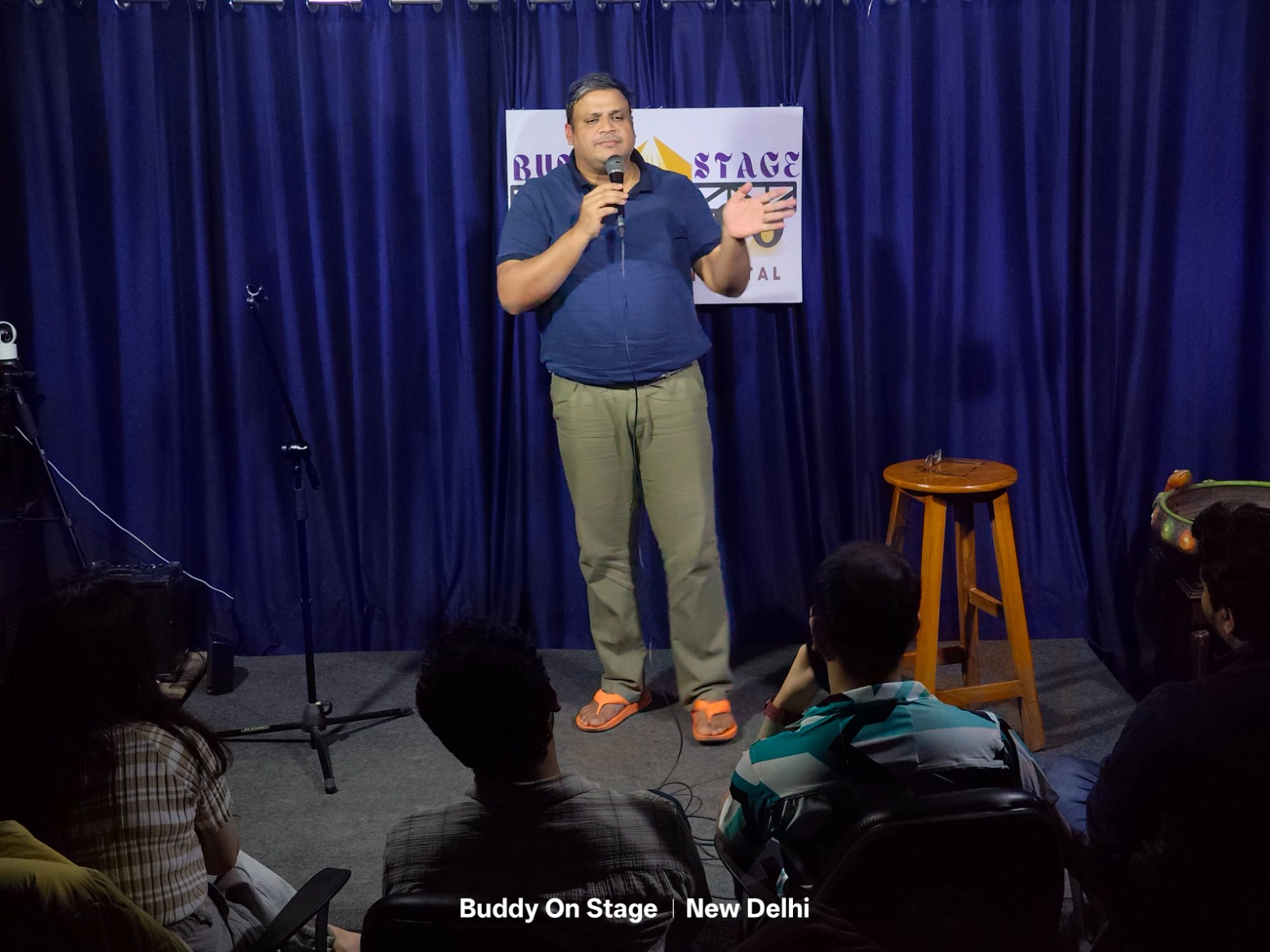
What The Audience Actually Notices During Your Set
Real audience attention during a 6-minute open mic is uneven and low-resolution. The moments they actually register:
- Your opening 10 seconds. Attention is highest here. First impression lands and then attention drifts.
- Jokes that make them laugh. The specific setup-punchline that caused the laugh gets stored briefly.
- Moments that make them uncomfortable. Uncomfortable silences, awkward pauses — these register more than jokes do.
- Your closing line. Attention spikes again at the end because they sense the set is wrapping up.
- Almost nothing in between unless specifically memorable. Middle minutes blur in audience memory.
Everything you will obsess over the next morning — the word you mispronounced, the exact hand position, the slight sweat, the one weak middle joke — goes completely unregistered by the audience. They were not running tape. They were living their evening.
The Friends Test
Here is an experiment you can run in 60 seconds. Think about the last open mic or comedy show you attended. Write down the comics you watched that night. Now write down one specific thing each of them did badly — a joke that did not land, an awkward moment, a stumble.
You probably cannot remember most of it. You might recall 1-2 big moments from 1-2 standout comics, and even those are hazy — possibly inaccurate — versions of what actually happened. That is how the audience will experience your set too. Hazy. Mostly forgotten by morning. Completely forgotten by next week.
The imagined judgement is worse than the real one
Step into a real room and the spotlight shrinks immediately. Book your Buddy On Stage mic now.
Register for an Open MicWhy This Unlocks Actual Performance
Once you genuinely internalise that nobody is watching as closely as you fear, three concrete things shift in your performance:
- You take bigger swings. The perceived cost of a flat joke drops to near-zero in audience memory, so you risk sharper material.
- You recover from weak moments faster. A stumble that you spent an hour dreading is forgotten by the audience by the time you deliver your next joke.
- You stop self-censoring mid-joke. The imagined judgement voice in your head loses authority once you accept the audience is not actually holding a scorecard.
- You perform with more presence. Ironically, releasing the fear of being watched makes you more watchable — relaxed performers read as confident.

What About Other Comedians In The Room?
Other comics are the most watchful segment of the audience — they pay close attention because they are studying. But they are also the most sympathetic. They know exactly what you are feeling because they felt it on their own first mics.
Most comics at an open mic are silently rooting for every performer. A good set from one comic makes the whole night better for everyone, and a bad set does not diminish anyone else — the comedy community is genuinely supportive at the beginner level. The rivalry narrative you might imagine is mostly fiction; the reality is a lot more collegial.
The Social Media Worry
Some beginners worry that a bad first set will go viral. It will not. Nobody films open-mic first sets and shares them. There is no audience for watching anonymous beginners bomb; the algorithm does not distribute that content. You are not the main character of anyone's Instagram story tonight.
Even if someone did film you (they will not), a 10-second clip of a beginner looking nervous has essentially zero viral potential. Your bomb is not newsworthy. Your success is not newsworthy either, yet. That freedom is actually a gift — you get to fail privately, learn, and grow before anyone is watching.
The Mental Reframe That Changes Everything
Replace the thought what will they think with what will I learn. The first question keeps you stuck in self-consciousness. The second gets you on stage. The second question is also, genuinely, the only useful one — because their thoughts are not your business, but your learning absolutely is.
"I spent three months obsessing over what the audience would think. First mic, I realised nobody was looking at me like I feared. Two people were on their phones. One person laughed unexpectedly. I walked off thinking "this was it?" in the best possible way."
The audience is not a panel of judges. They are tired people hoping the next 6 minutes makes them laugh. Give them something to laugh at — that is the only contract.